
Free Guide: Build a Stronger Music Studio Policy in Just 5 Steps!
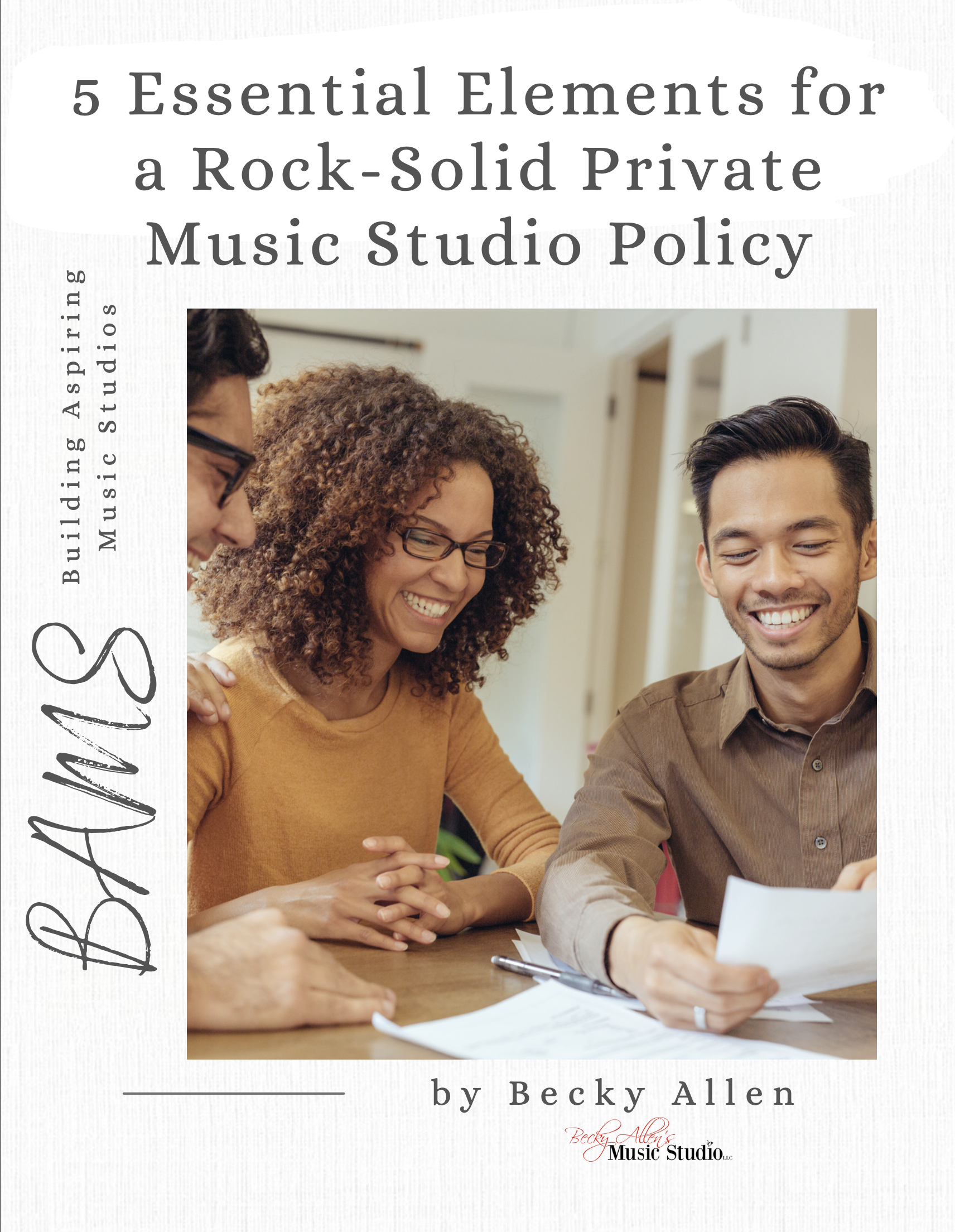
Crafting a strong studio policy can feel overwhelming — especially when you're not sure what to include, how formal it needs to be, or what happens if a family pushes back on it.
But here's what I've seen after nearly three decades of teaching: the teachers who have the most consistent income, the fewest difficult conversations, and the most professional relationships with their families almost always have one thing in common. They have a clear, written studio policy — and they hand it out before the first lesson, not after the first problem.
If you're building your policy from scratch or want to tighten up what you already have, this post walks you through the 5 essential elements every private music studio policy needs to include.
Why Your Studio Policy Is the Most Important Document in Your Business
Before we get into the five elements, let's talk about what a studio policy actually does — because it's more than a list of rules.
Your studio policy is the agreement that sets the tone for every relationship in your studio. It tells new families exactly what they're signing up for. It protects your income when someone cancels last minute or tries to quit without notice. It removes the awkwardness from difficult conversations because you're not making judgment calls on the fly — you're pointing to something you both signed.
Without it, you're running your business on assumptions. And assumptions are where income inconsistency, disrespect, and burnout come from.
Step 1 — Tuition and Payment Terms
This is the most critical section of your entire policy and the one most teachers either skip or keep vague.
Your payment section should clearly state: how much tuition is, when it's due, how it's collected, and what happens if it's late. Don't leave any of this open to interpretation. "Payment is due at the beginning of each month" is vague. "Tuition of $X is due on the 1st of each month via [payment method]. A $X late fee applies to payments received after the 5th." is a policy.
The more specific you are here, the less you'll ever need to chase payments or have uncomfortable money conversations.
Step 2 — Lesson Scheduling and Cancellations
Cancellations are the single biggest source of income inconsistency for private music teachers. Your policy needs to address them directly — before they happen.
Decide: how much notice is required to cancel a lesson? Do you offer makeups? If so, how many, and within what timeframe? What happens if a student no-shows without notice?
Your time has value whether a student shows up or not. A clear cancellation policy communicates that — and families who understand it upfront are far less likely to be casual about skipping lessons.
Just Getting Started?
Music Studio Startup Toolkit
Before you write your policy, you need your foundation in place — pricing, branding, business plan, and a clear 30-day launch roadmap. This 65-page toolkit walks you through every foundational decision before your first student walks in the door.
$50 · one-time · instant download
Get the Toolkit →Step 3 — Discontinuing Lessons
This one catches most teachers off guard — usually because they didn't include it and then a family quits mid-month with no warning.
Your policy should state clearly how much notice is required when a student wants to stop lessons. Two weeks? Thirty days? Whatever you decide, write it down and have families sign it. This protects your income when a spot opens unexpectedly and gives you time to fill it before it affects your monthly tuition.
Step 4 — Communication Expectations
How do families reach you? What's your response time? Is texting acceptable or do you prefer email?
This section might seem minor but it's the one that quietly prevents boundary issues. Without it, you'll find yourself answering texts at 10pm, fielding last-minute schedule changes, and feeling like your studio is running you instead of the other way around.
A simple statement — "All lesson scheduling and communication is handled via email. I respond to messages within 24 hours on teaching days." — sets a professional tone and protects your personal time.
Done-for-You Templates
Successful Music Studio Policy Templates
Don't write your policy from scratch. These fully customizable templates are already written — covering tuition, cancellations, scheduling, communication, and more. Includes a step-by-step tutorial video to help you customize everything to fit your studio.
Advanced adds income growth strategies, student retention, and referral incentive sections.
Step 5 — Getting It Signed and On File
A policy that isn't signed is just a suggestion.
I ask every new family to print two copies and bring them to the first lesson. I collect one signed copy for my records and they keep the other. That habit has saved me more difficult conversations than I can count — because when a situation comes up, we both have a copy of what we agreed to.
Already teaching without one? You can still implement a policy with current students. Let them know you've updated your studio guidelines and want everyone to have a current copy on file. It's a completely normal thing for a professional business to do — and it immediately raises the standard of how your studio operates.
Grab the Free Guide
Want a clear checklist of what to include? I've put together a free ebook — 5 Essential Elements for a Rock-Solid Private Music Studio Policy — that walks you through each section step by step.
Sign up below to get instant access.
Happy Teaching,
Becky
Keep the momentum going
What do you need help with next?
⭐ Start Here
🗺️ Build Your Studio Foundation
Startup Toolkit · $50 · Business plan, pricing, branding & 30-day roadmap →
📄 Get Your Studio Policy Done
Done-for-You Policy Templates · from $125 · Customizable & ready to sign →
🎓 Build a Studio That Runs Like a Business
Signature Course · 59 lessons · Everything to launch & grow →
🗺️ Not Sure Where to Start?
Free · 2 minutes · Start Here page →