

Post Categories: What do you need help with?
Starting Your Studio
Keep Your Studio Running
Making Your Studio Thrive
6 Tips for Students Who Won't Practice: What to Do When Motivation Disappears
It's week three of the new school year, and you already have a student sitting at the bench who clearly hasn't touched their instrument since last Tuesday. Maybe since last Tuesday two weeks ago.
You know the look. The vague shrug when you ask how practice went. The fumbling through a piece they had mostly learned. The sheepish parent text that says "we had a really busy week."
Every teacher deals with this. And if you've been teaching for any length of time, you've probably tried the obvious things — gentle reminders, stern conversations, sticker charts — with mixed results.
Here's the thing: students who don't practice aren't usually lazy. They're stuck. They don't know where to start, the habit hasn't formed yet, or they don't feel the connection between practicing and actually getting better. Your job isn't to lecture them into practicing — it's to remove the obstacles that are making it feel hard.
These six strategies actually work.
🎵 Tip 1: Find Out Why They're Not Practicing
Before you try to fix the problem, diagnose it. "Not practicing" is a symptom, not the actual issue — and the reasons vary widely by student.
Ask directly, but low-pressure: "What makes it hard to sit down and practice during the week?"
You'll be surprised what you hear. Common answers include:
They don't know what to practice. They open the book and don't know where to start, so they don't start at all.
They don't feel like they're making progress. If every session feels like failure, motivation evaporates fast.
There's a specific thing they hate. A piece that feels impossible, a technique that frustrates them, a scale that just won't click.
Life genuinely got in the way. Sports, homework, family stuff — it's real, and it's worth acknowledging.
The habit just hasn't formed yet. Especially true in the first few months of the school year.
Once you know why, you can actually help. A student who doesn't know what to practice needs a specific written assignment. A student who feels stuck needs a win. A student drowning in homework needs a five-minute plan they can actually do.
🎵 Tip 2: Give Them a Specific, Written Practice Assignment
"Practice your pieces" is not a practice plan. It's a wish.
Students — especially younger ones — need explicit, concrete direction. At the end of every lesson, give them a written assignment that answers three questions:
What to practice (specific pieces, specific sections, specific techniques)
How to practice it (hands separately, slowly, with the metronome, just measures 5–8)
How long to practice each thing (5 minutes on scales, 10 minutes on the new piece)
A simple lesson assignment notebook works well. Some teachers use a digital form or a notes app. The format doesn't matter — the specificity does. A student who has a clear checklist is far more likely to sit down and work through it than one who just has a vague sense that they're "supposed to practice."
When students come back having followed a written assignment, even imperfectly, celebrate it. That feedback loop — clarity leads to action, action leads to praise — is how the habit starts to form.
🎵 Tip 3: Shrink the Ask
One of the most effective and underused strategies for non-practicing students is simply making the daily goal smaller.
A student who hasn't established a practice habit cannot go from zero to 30 minutes a day. That's not how habits form. What works is tiny, consistent wins that build momentum over time.
Try giving a reluctant practitioner a five-minute assignment. Literally five minutes. One scale, one run-through of their piece, done. That's it.
Five minutes feels so small it removes the resistance entirely. And here's what almost always happens: they sit down for five minutes, get into it, and keep going. The hardest part of practicing is starting. A five-minute goal takes away the excuse not to start.
Once consistency is established — once they're sitting down most days without the battle — you can gradually expand the time. But consistency always comes before duration.
For parents: Frame it this way at the lesson. "I just want her to sit down for five minutes every day this week. That's the goal — not 30 minutes, not a perfect run-through. Just five minutes and she can be done." Parents will actually follow through with that. And so will the student.
🎵 Tip 4: Let Them Choose Something
Motivation is dramatically higher when students have some ownership over what they're working on.
This doesn't mean abandoning your curriculum. It means building in room for student choice — a piece they've asked to learn, a song from a movie or show they love, something they heard and wanted to play.
A student who has been begging to learn a specific song will practice it without being asked. That intrinsic motivation is powerful, and you can use it strategically. Pair the thing they want to learn with the technique they need to develop. Let the fun piece be the reward for working through the hard stuff.
At the start of the school year, ask every student: "Is there a song you've always wanted to learn?" Write it down. Work it into the plan when the level is appropriate. That moment when you pull out the sheet music for the song they requested six months ago — the look on their face is worth everything.
🎵 Tip 5: Bring the Parent Into the Plan
For younger students especially, practice doesn't happen without parent involvement. If a child isn't practicing, the teacher-student conversation is only half the equation.
The most effective approach is a clear, low-pressure communication to the parent that gives them a specific, actionable role — not a guilt trip, and not a lecture.
Something like: "I've noticed that [student] seems to struggle to get started during the week. I want to make it as easy as possible — would you be willing to just remind her at the same time every day and sit nearby for the first two minutes? You don't have to listen or help, just be there while she starts."
That's a concrete, doable ask. And parent presence at the start of a practice session makes a significant difference for young students.
If parent communication with your families feels scattered or reactive, that's often a systems issue — not a relationship issue. Having templates and a clear communication rhythm makes these conversations much easier to initiate and follow through on.
🎵 Tip 6: Know When It's a Bigger Conversation
Sometimes a student who stops practicing is telling you something beyond "I forgot." A sudden drop in engagement can signal burnout, a life change at home, loss of interest in the instrument, or a mismatch between where they are and what they're being asked to do.
If the strategies above aren't moving the needle after a few weeks, it's worth having a direct, curious conversation — not a frustrated one.
Ask: "Be honest with me — are you still enjoying lessons? Is there anything about what we're working on that you'd want to change?"
You might hear something surprising. Maybe the repertoire isn't connecting. Maybe they want to switch to a different style. Maybe they're exhausted from a packed schedule and need lessons to feel like a break, not another obligation.
Not every student who goes through a non-practicing phase is about to quit. Many just need to feel heard and have the plan adjusted. The teachers who retain students long-term are the ones who stay curious, communicate openly, and adapt — rather than just pushing harder on what isn't working.
And when a student genuinely has outgrown their motivation for lessons — that's okay too. How you handle that conversation matters for your reputation, your relationship with the family, and whether they'll refer other students to you someday.
A Final Word
The non-practicing student is one of the most universal challenges in private teaching — and one of the most solvable, when you approach it as a systems and communication problem rather than a motivation problem.
Give them clarity. Shrink the ask. Build in choice. Loop the parents in. Stay curious. Most students want to improve — they just need a teacher who makes the path forward feel doable.
That's exactly what you're already doing.
Happy Teaching!
Becky
🎃 The Holiday Practice Challenge Is Here — Two Years of Challenges, Zero Repeated Content

October is closer than it feels. And if you've ever hit week three of November wondering why half your students clearly haven't touched their instrument since the last lesson — you already know what the holiday slump looks like.
Schedules go sideways. School events pile up. Sports and family obligations compete with practice time. By Thanksgiving, the students who were doing so well in September have quietly checked out.
The Holiday Practice Challenge is the system that changes that — and this fall, it's bigger than ever.
🎃 What Is the Holiday Practice Challenge?
The Holiday Practice Challenge is a done-for-you, print-and-go practice system that carries your students from Halloween through Winter Break. Each kit includes:
Three monthly practice charts with seasonal designs for October, November, and December
A color-by-number practice chart students actually want to fill in every day
11 weekly bonus challenge cards — each with a technical task, a creative challenge, and a listening activity
A prize basket raffle system that gives students a concrete reason to bring their challenge cards to every lesson
A sticker chart template customizable for your entire studio roster
Clear challenge rules and how-it-works instructions for you and your families
You open the download, print everything, and hand it out at the first October lesson. That's the entire setup.
🍂 What's New This Year — Meet Set 2
Set 1 has been running in studios for a year now, and the response has been genuinely wonderful. Students coloring in their charts. Parents texting that their kids are asking to practice. Lessons filled with conversations about the weekly bonus challenges.
This fall, Set 2 launches — and it is a completely fresh second year.
Not a tweak. Not a light refresh. Every single weekly challenge theme, technique task, creative prompt, and listening activity is brand new. A student who ran Set 1 last year will never see a repeated challenge in Set 2. Not one.
Here's a side-by-side look at just October:
Week 1: Haunted House (Set 1) vs. Whispering Scales — E Harmonic Minor pianissimo (Set 2)
Week 2: Skeleton Dance (Set 1) vs. Phantom Rhythm — dotted rhythms with Long/Short pattern (Set 2)
Week 3: Pumpkin Parade (Set 1) vs. Shadow Steps — silent hand shifts between positions (Set 2)
Week 4: Spooky Sounds (Set 1) vs. Echo Etudes — compose a 2-bar echo motif (Set 2)
Week 5: Halloween medley listening (Set 1) vs. Haunted Harmony — g minor chord progressions and perform in costume (Set 2)
November and December are equally fresh — new themes, new challenges, new creative tasks all the way through.

Already Have Set 1? Here's Set 2
If you ran Set 1 last year and your students loved it — welcome back. Set 2 is ready for you.
Same system your students already know. New challenges they've never seen. You don't have to explain anything new — just hand out the October chart on the first lesson and they'll take it from there.
If you already own Set 1 and want to add Set 2 at a loyalty price, reach out directly and we'll work something out.
❄️ The 2-Year Bundle — Two Sets, One Download, Save $15
If you want to run the Holiday Practice Challenge for the next two years without ever repeating content, the 2-Year Bundle is the move.
Both sets in one download. Run Set 1 this year, Set 2 next year. Your students get a fresh challenge every fall, you never have to buy anything new, and you save $15 compared to buying them separately.
Here's what that looks like in practice:
Year 1: Your students run Set 1. They love the Haunted House scale challenge, the Gratitude Groove arpeggios, the Carol Countdown. They ask if you're doing it again next year.
Year 2: You hand out Set 2. Every challenge is brand new. Whispering Scales. Apple Arpeggios. Circle of Sound. They have no idea it's the same system — it just feels fresh.
Twenty-two total weekly challenges. Six monthly practice charts. Zero repetition. One $60 purchase.
One Final Thought
October comes fast. The challenge works best when students start from day one of the month — so the earlier you get set up, the more impact you'll see.
If you're new to the Holiday Practice Challenge, start with Set 1 and see what it does for your studio this fall. If you loved last year and want two years locked in, grab the bundle now and you're done.
Either way — your students are going to walk into that first October lesson with a reason to practice every single day.
Happy Teaching!
Becky
Fall Studio Kickoff Checklist
August arrives fast. One minute you're enjoying a slower summer schedule and the next you're two weeks out from the first lesson of fall with a list a mile long and no clear place to start.
I've been teaching since 1998, and I still do a full fall prep every single year. Not because I don't know what I'm doing — but because the teachers who walk into September feeling organized and ready are the ones who took a few intentional hours in August to get ahead of it.
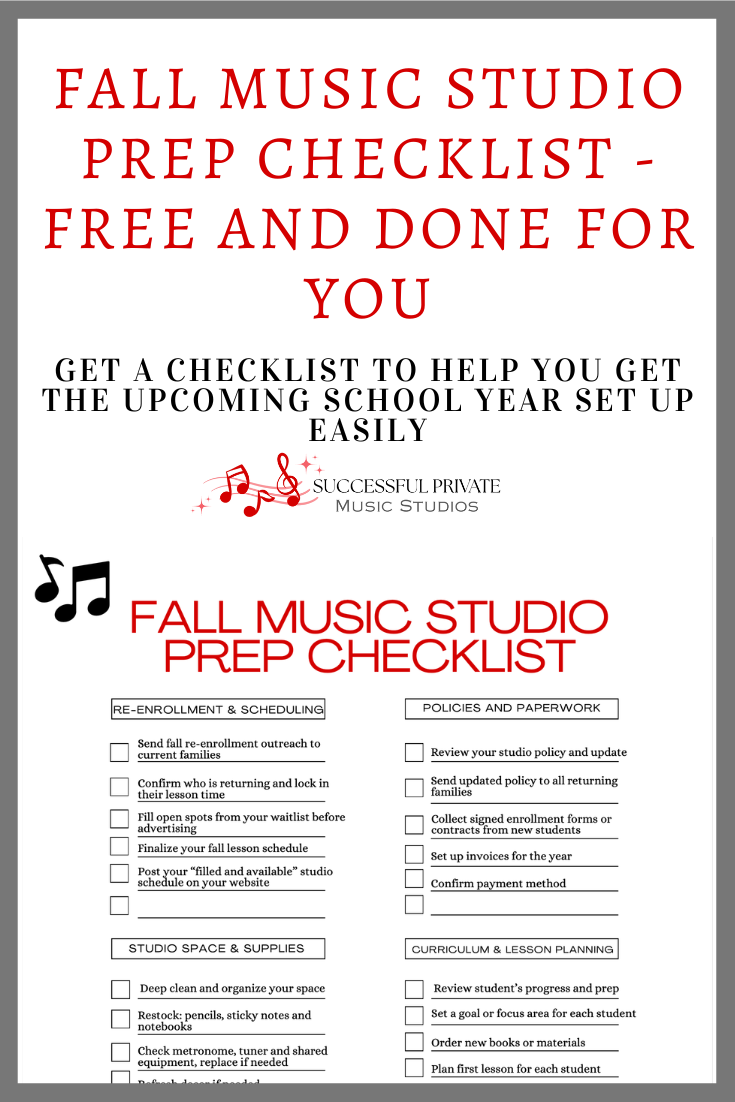
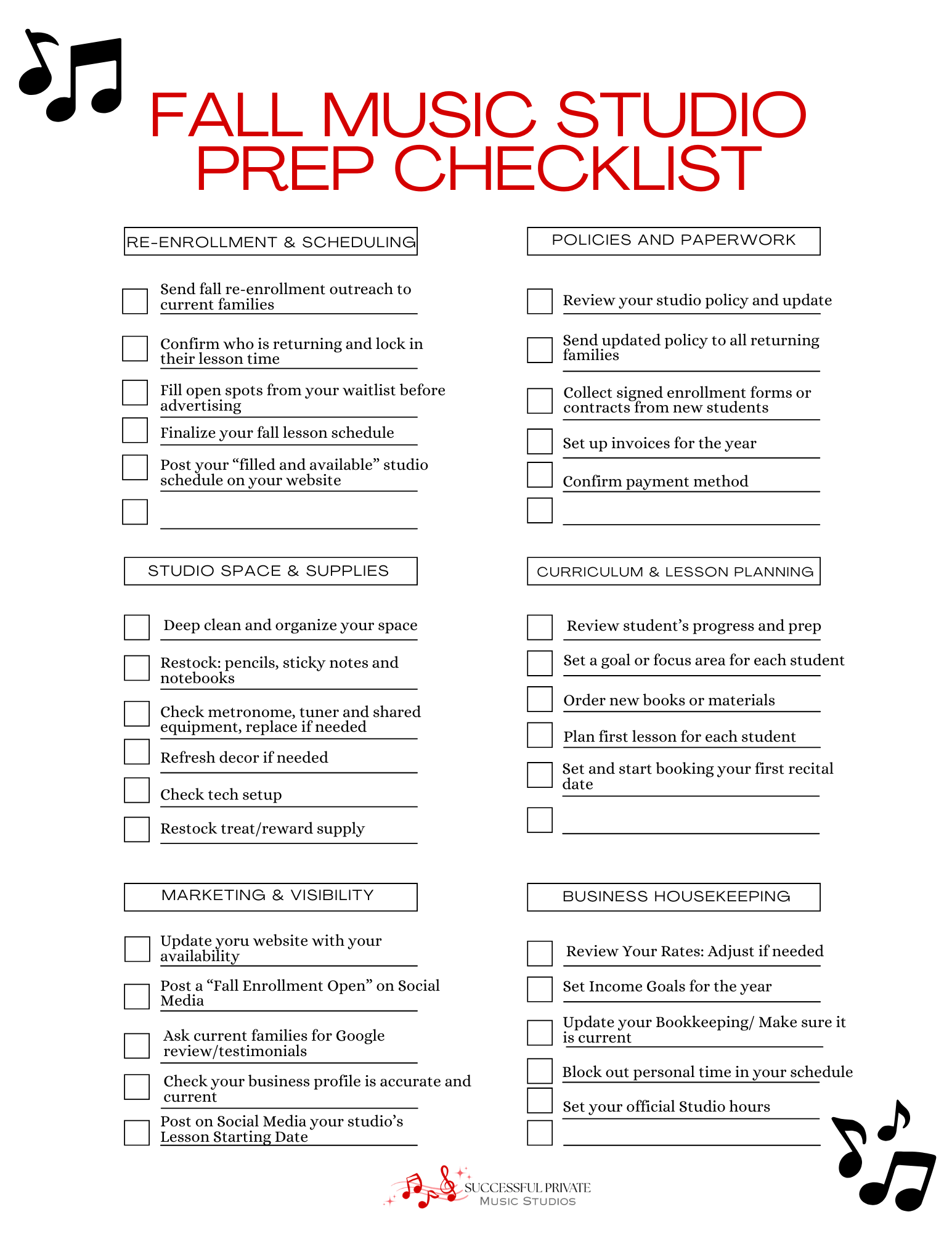
I put together a Fall Music Studio Prep Checklist (you can download the printable version above) that covers all six areas of your studio. Here's a little more detail on each section so you know what to actually do — not just what to check off.
Re-Enrollment and Scheduling
This is your first priority and your most time-sensitive one. Families make fall plans in July and August. If you wait until September to reach out, you'll lose students to schedule conflicts that could have been avoided.
Send a personal note — not a mass email blast — to each current family. Something simple: "We're gearing up for fall and I wanted to reach out before you finalize your schedule. I'd love to have [student name] back this year. Here are the lesson times I have available." That personal touch matters more than most teachers realize.
Once you know who's returning, fill any open spots from your waitlist before you advertise publicly. Your waitlist families have already said yes — they're the easiest enrollment you'll ever get. Confirm every family's lesson day and time in writing before the first week begins. A quick email confirmation prevents a surprising amount of scheduling confusion in September.
Policies and Paperwork
Fall is the natural reset point for your studio policy. Even if you're mostly happy with what you have, read through it with fresh eyes before the new year begins. Did anything cause friction last year — a payment dispute, confusion about makeup lessons, a family who didn't understand your cancellation policy? Fix it now, before it happens again.
Send your updated policy to all returning families for re-acknowledgment. Don't assume they remember what they signed a year ago. And for any new families enrolling this fall, collect signed enrollment forms and get payment set up before the first lesson — not after. Starting the relationship with those logistics in place sets the tone for a professional, well-run studio.
Studio Space and Supplies
Your teaching space sets the tone for every lesson. August is the perfect time to deep clean, reorganize, and refresh before the year begins. I'm not talking about a full renovation — just clearing the clutter, wiping things down, and making the space feel intentional again after a looser summer.
Restock your basics before the first week: pencils, sticky notes, assignment notebooks, and whatever you use for student rewards. Run out of pencils in week two and you'll be annoyed at yourself. Check your metronome, tuner, and any shared equipment — replace anything that's worn out or has dead batteries now rather than mid-lesson in October.
If you teach any online students, test your tech setup completely. Camera angle, audio quality, screen share if you use it, lighting. It all degrades quietly over summer when you haven't been using it consistently. Better to find the problem in August than five minutes before a lesson.
And don't overlook the small stuff: restock your treat bowl, put up a little fall decor, make the room feel like a place students want to be. These things sound minor but they add up to a studio culture that students genuinely look forward to walking into each week.
Curriculum and Lesson Planning
Before fall lessons begin, sit down with your notes from spring and review where each student left off. What were they working on? What was going well? What needed more time? What's the logical next step for each one?
Set a goal or focus area for each student for the fall semester — not a rigid plan, just a direction. "This year I want to focus on building Emma's sight-reading" or "Marcus is ready to start working on an audition piece" is enough. Write it down somewhere you'll actually look at it. Students who are working toward something specific practice more and stay enrolled longer.
Order any new method books or materials now so they arrive before lessons start. And plan your first lesson for each student in advance — don't wing the first week back. A strong first lesson sets the tone for the whole semester.
Set your fall recital date while you're at it. Book the venue early — good spaces fill up fast, especially in November and December. Getting that date on the calendar gives students a goal to work toward from day one.
Need a Studio Policy That Actually Works?
Done-For-You Studio Policy Templates
Stop writing your policy from scratch every fall. These done-for-you templates cover tuition, cancellations, makeups, scheduling, and more — fully customizable in Word or Mac Pages. Includes a tutorial video so you can get it done fast.
Marketing and Visibility
Even if your studio is full going into fall, your online presence still deserves a quick refresh in August. Update your website to reflect your current availability — "fully booked for fall" is actually a great thing to post, because it signals demand and keeps your waitlist growing. If you have open spots, say so clearly and make it easy for families to reach out.
Post a "fall enrollment open" announcement to social media before your schedule fills. A simple post with your instruments, availability, and a clear call to action does the job. You don't need a graphic or a campaign — just a direct, friendly post that tells people lessons are starting.
Check that your Google Business Profile is accurate and up to date. Hours, contact info, website link — all of it. This is what shows up when a parent Googles "music lessons near me," and an outdated listing costs you inquiries you never even know you lost.
While you're at it, ask one or two happy current families for a Google review. The end of summer — when they're thinking about fall and feeling good about returning — is a natural moment to ask. Most families are glad to do it, they just need the nudge.
Business Housekeeping
Fall is also the right time to look at your numbers with fresh eyes. Review your rates — honestly. Have your expenses gone up? Has your market changed? Have you been teaching at the same rate for more than a year without revisiting it? If a rate increase makes sense, communicate it to families in August with enough notice that it doesn't feel like a surprise.
Set an income goal for the fall semester. Not a vague "I want to earn more" — an actual number. How many students do you need at your current rate to hit it? How many open slots do you have? What would it take to get there? Knowing your target changes how you make decisions all semester long.
Update your bookkeeping before the new year starts. Reconcile the summer, make sure everything is current, and go into fall with a clean slate financially. If your bookkeeping system is a mess or nonexistent, that's worth fixing now before you add a full roster of fall students to the chaos.
And finally — block out your own time off before the schedule fills in. Every holiday, every personal commitment, every break you want to take this fall. Put it on the calendar now, communicate it to families in your fall welcome communication, and protect it. You can't run a great studio if you never come up for air.
Work through all six sections over the next few weeks and you'll start September feeling like you're ahead of it rather than chasing it. That feeling carries through the whole semester.
Happy Teaching!
Becky
Want the Complete System Behind a Thriving Fall?
Successful Music Studio Strategies — Signature Course
59 lessons covering re-enrollment strategy, student retention, studio policy, recital planning, marketing, and more — everything you need to walk into every fall fully prepared and fully booked.
$1,250 or 3 payments of $500
Learn More →What do you want to tackle next?
Here are the best next steps depending on where you are right now.
4 Things to Do This Summer to Reset, Refresh, and Prep Your Music Studio for Fall
For most music teachers, summer looks like a mix of lighter lessons, a little breathing room, and — if we're being honest — a pile of studio tasks that have been quietly building since January.
But summer isn't just a slower season. It's your best window of the year to work on your studio instead of just in it. A few intentional hours between now and back-to-school can mean the difference between a chaotic September and one where you walk in knowing exactly where you stand — fully booked, organized, and ready.
Here are four things I do every summer to reset, refresh, and set my studio up for a strong fall.
1. Reset Your Studio Space
Before anything else, I do a physical reset. Whether you teach in a dedicated studio room, a corner of your home, or at students' houses, things accumulate over a school year. Sheet music gets shuffled. Supplies run low. That one stack of papers you've been meaning to sort since March is still sitting there.
Summer is the time to deal with it.
Go through your teaching materials and pull anything you're no longer using. Restock the supplies that ran out — pencils, sticky tabs, practice charts, whatever you reach for regularly. If you have a waiting area, a whiteboard, or any student-facing space, freshen it up. A clean, organized environment affects how you feel when you walk in to teach — and students and parents notice it too.
This doesn't have to take a whole day. Even two focused hours can transform a cluttered space into one that feels intentional and professional.
2. Update Your Templates and Studio Documents
This is the quiet administrative work that pays off all year. Just like the year-end Great Reset, summer is a natural time to review and refresh the core documents your studio runs on.
Work through this list before fall:
Lesson summary templates — update any dates or headers, make sure the format still works for how you teach
Payment receipt templates — confirm your rates are reflected accurately, especially if you raised them
Welcome packets or new family handouts — anything a new student would receive on day one
Studio policy — read through it with fresh eyes. Does it still reflect how you actually run your studio? Are there gaps or situations from last year that your policy didn't cover?
That last one catches most teachers off guard. Policies tend to get written once and forgotten — until a situation comes up that your policy doesn't address. Summer is the time to close those gaps, before a new family walks through the door expecting clear answers.
Done-for-You Templates
Successful Music Studio Policy Templates
If your policy needs more than a quick edit — or you don't have one yet — these customizable templates cover tuition, cancellations, scheduling, communication, and more. Includes a tutorial video and lifetime access.
Adds income growth, student retention, and referral sections.
3. Prep for Fall Enrollment
This is the one that makes the biggest difference in how September feels — and it's the step most teachers either skip or leave too late.
Here's how I handle it: by the end of July, I reach out to every existing family to confirm whether they're returning in the fall and to lock in their lesson time. I don't wait for them to reach out to me. I initiate the conversation, get a commitment, and put it on the schedule.
Why does this matter? Because by the time school starts, I know exactly where I stand. I know which spots are filled, which are open, and how many new students I have room for. There's no guessing. No last-minute scramble. No September where I'm still trying to figure out my schedule while also teaching 20 lessons a week.
A simple reach-out message goes a long way. Something like: "Hi! I'm getting the fall schedule set up and wanted to reach out early to lock in your regular lesson time before spots fill up. Are you planning to continue in the fall?" That's it. Short, warm, and it creates a gentle sense of urgency without pressure.
From there, keep a running list — returning students confirmed, returning students pending, open slots. Update it as responses come in. By the first week of August, you'll have a clear picture of where you need to focus your enrollment energy.
If you have openings, now is also the time to let people know. A quick social media post, a note in your studio newsletter, or even just word-of-mouth through current families can fill spots before the school year even starts.
Just Getting Started?
Music Studio Startup Toolkit
If you're launching a new studio this fall, this is your starting point. A 65-page framework covering your business plan, pricing, branding, policy basics, and a full 30-day launch roadmap — so you walk into September with a real plan, not just a hope.
$50 · one-time · instant download
Get the Toolkit →4. Set Your Goals for the New Studio Year
The school year start is a natural reset point — and it's the perfect time to decide, intentionally, what you want this year to look like.
Not in a vague "I want to do better" way. In specifics.
How many students do you want to have by October? What's your monthly income target? Is there one thing about how you ran your studio last year that you want to change — a policy you never enforced, a schedule boundary that didn't hold, a recital you want to do differently?
Write it down. Even three clear goals for the year gives you something to come back to in January when things feel overwhelming, or in May when you're deciding whether to add a student or hold your ground on a boundary.
Some questions worth sitting with:
Did I end the school year at the income I wanted? If not, what needs to change?
Were my studio policies working, or did I make exceptions that cost me time and energy?
What's one thing I want to add, improve, or let go of this year?
This doesn't require a long planning session. Thirty minutes with a notebook and a cup of coffee will do it. What matters is that you enter September with intention — not just momentum.
Summer is short, and it goes fast. But a few focused hours now means you walk into fall with a full schedule, a clean studio, updated systems, and a clear direction. That's not just organization — that's confidence.
Happy Teaching!
Becky
Keep the momentum going
What do you need next?
⭐ Start Here
🗺️ Launch Your Studio This Fall
Startup Toolkit · $50 · Business plan, pricing, branding & 30-day roadmap →
📄 Get Your Studio Policies Set
Done-for-You Policy Templates · from $125 · Ready to customize →
🎓 Build a Studio That Runs Like a Business
Signature Course · 59 lessons · Everything to launch & grow →
🗺️ Not Sure Where to Start?
Free · 2 minutes · Start Here page →
How to Start a Music Studio from Scratch (Without the Overwhelm)
A step-by-step guide for new music teachers who are ready to turn their passion into a real, profitable business.
So you've decided to start a music studio. Maybe you've been teaching a few students informally, or maybe this is a brand new idea still bouncing around in your head. Either way — welcome. You're in the right place.
Starting a private music studio is one of the most rewarding things you can do as a musician and teacher. But if you've ever Googled "how to start a music studio," you know the results are... a lot. Conflicting advice. Vague tips. Nothing that actually tells you what to do first.
That's exactly what this post is for. Let's walk through the foundational steps — in order — so you can stop overthinking and start building.
Step 1: Start with a real business plan
I know, I know. "Business plan" sounds intimidating. But it doesn't have to be a 40-page document. For a private music studio, your business plan is simply a clear picture of what you're building, who it's for, and how you'll sustain it.
Ask yourself: How many students do I want? What instrument(s) will I teach? Will I teach in-home, in a rented space, or online? Who is my ideal student — beginners, advanced players, adults, children?
Getting these answers on paper before you do anything else will save you hours of second-guessing later. It becomes your decision-making filter for everything that follows.
Step 2: Set your rates with confidence
Pricing is where most new studio owners get stuck — and where most undercharge. Setting your rates too low is one of the most common and costly mistakes in this business, and it's surprisingly hard to fix once parents expect a certain number.
A few things to factor in when setting your rates:
Your local market rate (what are other teachers in your area charging?)
Your experience, credentials, and specializations
Your income goals — reverse-engineer your monthly target
The cost of your time, materials, and overhead
Don't price based on what you think people will pay. Price based on what you need to make your studio sustainable — and then build the confidence to stand behind it.
Step 3: Build your studio policies before you take your first student
This is the step most new teachers skip — and they regret it almost immediately. Studio policies aren't just bureaucratic paperwork. They are the foundation of a professional, respectful relationship with your students and their families.
A solid studio policy covers:
Cancellation and make-up lesson procedures
Payment terms and due dates
Scheduling and availability boundaries
Communication expectations (how and when to reach you)
Student and parent behavior expectations
Setting these expectations from day one prevents the awkward conversations that drain your energy and erode the teacher-student relationship. The time to establish your policies is before problems arise — not after.
Step 4: Build your brand
Your brand is more than a logo. It's the feeling people get when they land on your website, receive a message from you, or walk into your studio space. It's the reason a parent chooses you over the next teacher on the list.
You don't need to hire a designer or spend thousands on branding. You need:
A clear studio name that's memorable and searchable
A consistent color palette and font style
A professional profile photo
A simple, clean website with your rates, contact info, and a way to enroll
Consistency is more important than perfection. Show up the same way every time, and trust builds naturally.
Step 5: Follow a launch roadmap — don't just wing it
The difference between teachers who launch successfully and those who stay stuck in "almost ready" mode is usually one thing: a plan with deadlines.
A 30-day launch roadmap breaks your studio launch into small, daily actions so that you always know exactly what to do next. No more decision fatigue. No more blank-page paralysis. Just momentum.
Whether you're launching in 30 days or 90, mapping out your milestones ahead of time gives you something to move toward — and something to celebrate along the way.
Ready to go deeper?
These five steps will get your studio off the ground. But building a studio that's truly profitable, sustainable, and fulfilling over the long haul takes more — it takes systems. For pricing, marketing, student retention, bookkeeping, recitals, and growth.
That's exactly what the Successful Music Studio Strategies Course is built for.
Not ready for the full course yet? Start with the Music Studio Startup Toolkit — just $50, and it's the perfect first step.
Happy Teaching!
Becky


I’m Becky and Welcome To Successful Music Studio Strategies where I help you create your own Successful Private Music Studio business through simple strategies I’ve learned and used in my own successful private music studio! Want to learn more about my online courses to help you start, build and create a successful and THRIVING music studio? Click here!