
Summer Practicing Tips to Share With Your Music Students (+ Free Printable!)
Every music teacher knows the feeling. Students walk back through the door in September and it's like the last three months never happened. Scales are shaky. Songs they had memorized are gone. And you spend the first few weeks of fall just getting back to where you were in June.
It doesn't have to be that way — but it takes a little strategy on your end.
One of the most powerful things you can do before summer break is give your students (and their parents) a clear, simple plan. Not a lecture. Not a guilt trip. Just a friendly guide that sets them up to keep the momentum going while they're out of the routine of weekly lessons.
That's exactly what this post is about. Below are the key summer practicing tips I recommend sharing with your students — organized by category so you can talk through them at the last lesson of the year. And at the bottom, you can grab a free printable checklist to send home with every student.
Why Summer Is Actually a Great Time to Practice
Before we get into the tips, it's worth reframing summer for your students. Regular practicing during break has some real advantages:
No recital pressure. Summer is the perfect time to learn something just for fun.
More flexible scheduling. Without school homework, there's often more space in the day.
Room to explore. Students can spend time on music they love, not just what they're preparing for a performance.
When you help students see summer as an opportunity rather than a break from obligation, they're more likely to sit down at the instrument.
Tip Category 1: Keep It Short and Consistent
The biggest mistake students make over the summer is going all-or-nothing. Either they practice for an hour because they have time... or they don't practice at all because they don't feel like it.
Tips to share with students:
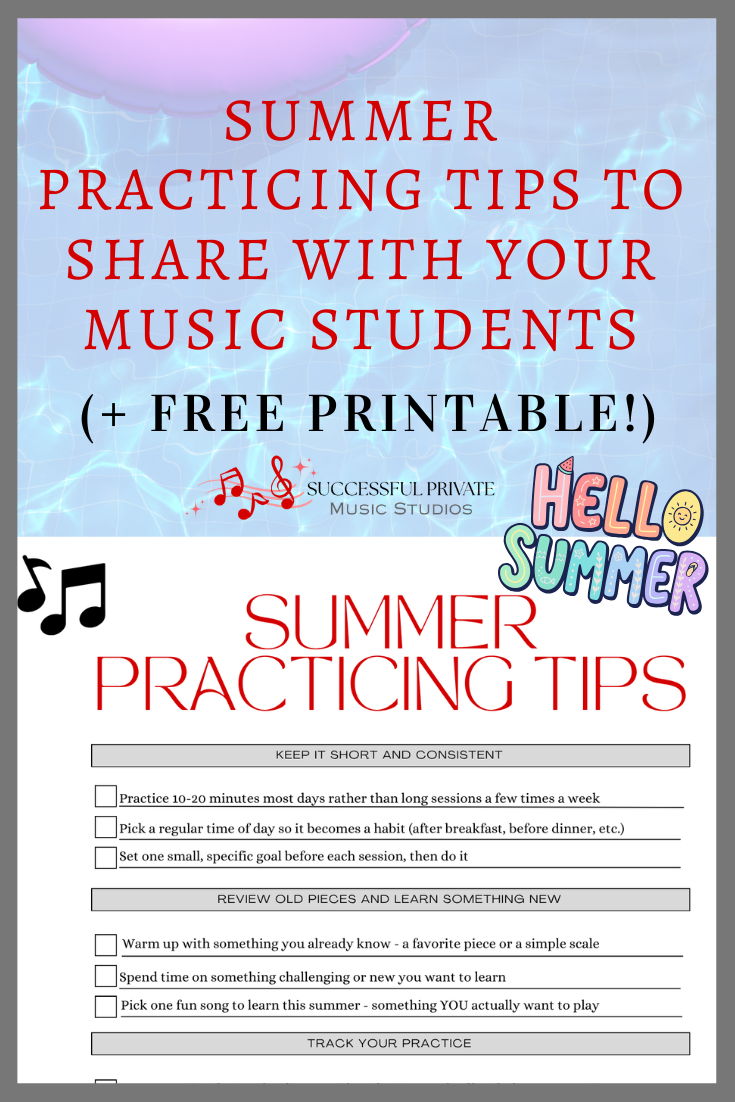
Aim for 10–20 minutes most days rather than long sessions a few times a week. Consistency beats duration every time.
Pick a regular time of day — right after breakfast, before lunch, or after dinner — so it becomes a habit rather than a decision.
Set a small, specific goal for each session. "I will play my scale hands together three times without stopping" is more motivating than "I'll practice."
What to tell parents: Consistency is more important than length. Even 10 minutes a day keeps skills alive. If your child plays for 10 minutes and then wants to keep going — great! But don't require more than that.
Tip Category 2: Review What They Know AND Learn Something New
Students tend to drift toward one extreme: either only playing things they already know (comfort zone) or only drilling the hard stuff (not fun). A balanced session does a little of both.
Tips to share with students:
Spend the first few minutes warming up with something familiar — a piece they've already mastered, a simple scale, or a favorite song.
Then spend time with something new or challenging — a piece they're working toward, a technique they're building, or a song they've always wanted to learn.
Learning a song they actually want to play (a pop song, a movie theme, a piece by a favorite artist) is a great summer project and keeps motivation high.
Teacher tip: Before the last lesson, assign at least one "fun" piece to learn over the summer alongside their regular work. Give them something to look forward to showing you in the fall.
Tip Category 3: Use a Practice Chart
Students do better when there's something to track. A simple practice chart — even just a calendar where they color in the days they practiced — creates a visual record that feels satisfying to fill in.
Tips to share with students:
Put the practice chart somewhere visible: on the fridge, above the piano, or in their lesson binder.
Mark off each day they practice, even if it was just a short session.
At the end of summer, look back at the whole chart. That visual record is genuinely motivating.
You can hand out a blank monthly calendar, a sticker chart, or a simple practice log — whatever matches the age and personality of the student.
New to studio life? Start here.
Need a fast, solid foundation before you hand students anything?
The Music Studio Startup Toolkit is a 65-page resource that covers pricing, policies, branding, and a 30-day roadmap — everything you need to look and run like a professional studio from day one. It's the place to start if you're still building your systems.
Get the Music Studio Startup Toolkit →
One-time · $50 · Instant access · 65 pages
Tip Category 4: Record Yourself
Summer is a fantastic time to start a simple recording habit. Students don't need any special equipment — a phone works perfectly.
Tips to share with students:
Once a week, record yourself playing one piece all the way through. Don't stop to fix mistakes — just play it.
Listen back. What sounds great? What would you fix?
Keep a short playlist of your recordings throughout the summer. By August, you'll be amazed how much you've improved.
This builds self-awareness and listening skills that are hard to teach directly. It's also a wonderful thing to bring to the first fall lesson.
Tip Category 5: Stay Connected to Music (Even Without Practicing)
Life gets busy in the summer. Some weeks, regular practice sessions may not happen — and that's okay. Students can still stay connected to music in ways that matter.
Tips to share with students:
Listen to music intentionally. Listen for the instrument you play. Notice the rhythm, the melody, the dynamics.
Watch a live performance on YouTube — an orchestra concert, a soloist, a band. It's surprisingly inspiring.
Attend a local concert if the opportunity comes up.
Hum or sing through a piece you're learning, even without the instrument in front of you.
Staying connected to music mentally keeps students in the mindset of a musician, even during a lighter practicing week.
Free Printable: Summer Practicing Tips Checklist for Students
To make it easy to share these ideas with your students, I've put together a clean, print-friendly one-page checklist summarizing the key tips above.
It's simple, student-friendly, and designed to be sent home at the last lesson of the year — or emailed to families along with your end-of-year studio newsletter.
The checklist includes:
Short, student-readable tips organized by category
A section for students to write their own summer practice goal
A reminder of the first day back for lessons (you can fill this in!)
It's the kind of thing that costs you almost nothing to share, but shows your families that you're invested in their progress even when lessons aren't in session.
Get your free Summer Practicing Tips Checklist →
Sign up below and I'll send it straight to your inbox.
[First Name] [Last Name] [Email Address] [Submit]
No spam. Just practical tools and tips to help your studio thrive.
A Few Final Words for Teachers
Handing out a tip sheet doesn't replace the conversation — it reinforces it. Take 5 minutes at your last lesson of the year to talk through the summer plan with your student. Ask them what piece they want to learn. Help them set one specific goal. Make it feel like a challenge they're excited about, not homework they have to do.
The students who come back in the fall having maintained their skills aren't necessarily the most talented — they're the ones who had a clear plan and a teacher who set them up for success.
You're already doing that just by being here.
Happy Teaching!
Becky
What do you want to tackle next?
You've got the tips — here are the best next steps depending on where you are right now.