

Post Categories: What do you need help with?
Starting Your Studio
Keep Your Studio Running
Making Your Studio Thrive
How To Survive The Holiday Rush As A Music Teacher

The Holidays ARE here — and no matter how the year went, this is your chance to close it out well and set yourself up for the strongest January you've ever had.
I'm a big believer in the year-end reset. Not as a time to beat yourself up over what didn't happen, but as a genuine opportunity to look at what's working, clear out what isn't, and intentionally design what comes next.
Here's my complete year-end reset process for private music teachers.
Step 1: Do a quick studio audit
Before you can plan forward, take an honest look at where you are right now. Spend 20–30 minutes answering these questions:
📋 Students
- • How many active students do you have right now?
- • How many do you want in January?
- • Which students are thriving? Which might not re-enroll?
- • Do you have a waitlist, or open spots to fill?
💰 Income
- • Did you hit your income goal this year?
- • Are your rates where they should be?
- • Are you leaving money on the table with unclear tuition or cancellation terms?
⚙️ Systems
- • Is your studio policy current and covering everything it should?
- • How is your scheduling system working?
- • Is your communication with families consistent?
Step 2: Update your studio policy before January
January is the perfect time to put a refreshed policy in front of your families — whether you're making changes or just want everyone to re-acknowledge the existing one. This is completely normal and professional, and most families appreciate the clarity.
Review these sections especially:
- • Tuition rate — are you increasing in January?
- • Missed lesson and cancellation policy
- • Holiday and break schedule for the coming year
- • Communication expectations
Start January with a solid foundation
Get the done-for-you policy template — ready to hand to families in January
The Basic Music Studio Policy Template is fully written and ready to customize with your studio name, rates, and details. Every section you need — tuition, cancellations, makeups, holidays, and communication — already done for you.
- ✓ All sections written — just fill in your details
- ✓ Works in Microsoft Word and Mac Pages
- ✓ Includes a 17-minute tutorial video walking you through every section
- ✓ Lifetime access — update it every January as your studio evolves
One-time · $125 · Instant access · Works in Word and Mac Pages
Step 3: Set 3 studio goals for the new year
Not 10. Not a giant vision board. Just 3 clear, specific goals for your studio in 2027.
- • "I want to go from 12 students to 18 students by June"
- • "I want to raise my rates by $10/month in January and keep all my current students"
- • "I want to launch one digital product by March"
- • "I want to host two recitals this year instead of one"
Write them down somewhere you'll see them. Tell someone. Make them real.
Step 4: Plan your January enrollment push
The teachers who have full rosters in January started talking about it in November and December. If you haven't yet, it's not too late — but start now.
- • Update your website with January availability
- • Send a re-enrollment email to current families
- • Pin your beginner-friendly content heavily — "how to start music lessons" searches spike in December
In December, Pinterest searches for "beginner piano" and "music lessons for kids" spike after holiday gift-giving. If your content is there, you'll catch that traffic right when intent is highest.
Step 5: Give yourself credit
Teaching private music is hard, beautiful, demanding, creative work. You showed up for your students every week. You navigated schedule changes and difficult conversations and the endless challenge of keeping kids motivated.
That's worth acknowledging.
Before you dive into January planning mode, take a moment to recognize what went well this year. What are you proud of? What moments reminded you why you do this? Write them down. You'll want to remember them on the hard days next year.
Here's to a strong finish and an even stronger start.
Happy Teaching!
Becky
Make 2027 your best studio year yet
Ready to build your studio the right way — from start to thriving?
The Complete Studio Strategies Course covers all three phases — getting started, keeping it running, and making it thrive. Everything you need to build a sustainable, profitable private music studio in one place.
- ✓ Part 1: Getting Started — enrollment, pricing, policies, branding
- ✓ Part 2: Keeping It Running — systems, scheduling, bookkeeping
- ✓ Part 3: Making It Thrive — marketing, growth, recitals, retention
- ✓ Lifetime access — revisit any module whenever you need it
All three parts · $1,250 · Lifetime access
Where do you want to take your studio in 2027?
Here are the best next steps depending on where you are right now.

6 Tips for Students Who Won't Practice: What to Do When Motivation Disappears
It's week three of the new school year, and you already have a student sitting at the bench who clearly hasn't touched their instrument since last Tuesday. Maybe since last Tuesday two weeks ago.
You know the look. The vague shrug when you ask how practice went. The fumbling through a piece they had mostly learned. The sheepish parent text that says "we had a really busy week."
Every teacher deals with this. And if you've been teaching for any length of time, you've probably tried the obvious things — gentle reminders, stern conversations, sticker charts — with mixed results.
Here's the thing: students who don't practice aren't usually lazy. They're stuck. They don't know where to start, the habit hasn't formed yet, or they don't feel the connection between practicing and actually getting better. Your job isn't to lecture them into practicing — it's to remove the obstacles that are making it feel hard.
These six strategies actually work.
🎵 Tip 1: Find Out Why They're Not Practicing
Before you try to fix the problem, diagnose it. "Not practicing" is a symptom, not the actual issue — and the reasons vary widely by student.
Ask directly, but low-pressure: "What makes it hard to sit down and practice during the week?"
You'll be surprised what you hear. Common answers include:
They don't know what to practice. They open the book and don't know where to start, so they don't start at all.
They don't feel like they're making progress. If every session feels like failure, motivation evaporates fast.
There's a specific thing they hate. A piece that feels impossible, a technique that frustrates them, a scale that just won't click.
Life genuinely got in the way. Sports, homework, family stuff — it's real, and it's worth acknowledging.
The habit just hasn't formed yet. Especially true in the first few months of the school year.
Once you know why, you can actually help. A student who doesn't know what to practice needs a specific written assignment. A student who feels stuck needs a win. A student drowning in homework needs a five-minute plan they can actually do.
🎵 Tip 2: Give Them a Specific, Written Practice Assignment
"Practice your pieces" is not a practice plan. It's a wish.
Students — especially younger ones — need explicit, concrete direction. At the end of every lesson, give them a written assignment that answers three questions:
What to practice (specific pieces, specific sections, specific techniques)
How to practice it (hands separately, slowly, with the metronome, just measures 5–8)
How long to practice each thing (5 minutes on scales, 10 minutes on the new piece)
A simple lesson assignment notebook works well. Some teachers use a digital form or a notes app. The format doesn't matter — the specificity does. A student who has a clear checklist is far more likely to sit down and work through it than one who just has a vague sense that they're "supposed to practice."
When students come back having followed a written assignment, even imperfectly, celebrate it. That feedback loop — clarity leads to action, action leads to praise — is how the habit starts to form.
🎵 Tip 3: Shrink the Ask
One of the most effective and underused strategies for non-practicing students is simply making the daily goal smaller.
A student who hasn't established a practice habit cannot go from zero to 30 minutes a day. That's not how habits form. What works is tiny, consistent wins that build momentum over time.
Try giving a reluctant practitioner a five-minute assignment. Literally five minutes. One scale, one run-through of their piece, done. That's it.
Five minutes feels so small it removes the resistance entirely. And here's what almost always happens: they sit down for five minutes, get into it, and keep going. The hardest part of practicing is starting. A five-minute goal takes away the excuse not to start.
Once consistency is established — once they're sitting down most days without the battle — you can gradually expand the time. But consistency always comes before duration.
For parents: Frame it this way at the lesson. "I just want her to sit down for five minutes every day this week. That's the goal — not 30 minutes, not a perfect run-through. Just five minutes and she can be done." Parents will actually follow through with that. And so will the student.
🎵 Tip 4: Let Them Choose Something
Motivation is dramatically higher when students have some ownership over what they're working on.
This doesn't mean abandoning your curriculum. It means building in room for student choice — a piece they've asked to learn, a song from a movie or show they love, something they heard and wanted to play.
A student who has been begging to learn a specific song will practice it without being asked. That intrinsic motivation is powerful, and you can use it strategically. Pair the thing they want to learn with the technique they need to develop. Let the fun piece be the reward for working through the hard stuff.
At the start of the school year, ask every student: "Is there a song you've always wanted to learn?" Write it down. Work it into the plan when the level is appropriate. That moment when you pull out the sheet music for the song they requested six months ago — the look on their face is worth everything.
🎵 Tip 5: Bring the Parent Into the Plan
For younger students especially, practice doesn't happen without parent involvement. If a child isn't practicing, the teacher-student conversation is only half the equation.
The most effective approach is a clear, low-pressure communication to the parent that gives them a specific, actionable role — not a guilt trip, and not a lecture.
Something like: "I've noticed that [student] seems to struggle to get started during the week. I want to make it as easy as possible — would you be willing to just remind her at the same time every day and sit nearby for the first two minutes? You don't have to listen or help, just be there while she starts."
That's a concrete, doable ask. And parent presence at the start of a practice session makes a significant difference for young students.
If parent communication with your families feels scattered or reactive, that's often a systems issue — not a relationship issue. Having templates and a clear communication rhythm makes these conversations much easier to initiate and follow through on.
🎵 Tip 6: Know When It's a Bigger Conversation
Sometimes a student who stops practicing is telling you something beyond "I forgot." A sudden drop in engagement can signal burnout, a life change at home, loss of interest in the instrument, or a mismatch between where they are and what they're being asked to do.
If the strategies above aren't moving the needle after a few weeks, it's worth having a direct, curious conversation — not a frustrated one.
Ask: "Be honest with me — are you still enjoying lessons? Is there anything about what we're working on that you'd want to change?"
You might hear something surprising. Maybe the repertoire isn't connecting. Maybe they want to switch to a different style. Maybe they're exhausted from a packed schedule and need lessons to feel like a break, not another obligation.
Not every student who goes through a non-practicing phase is about to quit. Many just need to feel heard and have the plan adjusted. The teachers who retain students long-term are the ones who stay curious, communicate openly, and adapt — rather than just pushing harder on what isn't working.
And when a student genuinely has outgrown their motivation for lessons — that's okay too. How you handle that conversation matters for your reputation, your relationship with the family, and whether they'll refer other students to you someday.
A Final Word
The non-practicing student is one of the most universal challenges in private teaching — and one of the most solvable, when you approach it as a systems and communication problem rather than a motivation problem.
Give them clarity. Shrink the ask. Build in choice. Loop the parents in. Stay curious. Most students want to improve — they just need a teacher who makes the path forward feel doable.
That's exactly what you're already doing.
Happy Teaching!
Becky
Fall Studio Kickoff Checklist
August arrives fast. One minute you're enjoying a slower summer schedule and the next you're two weeks out from the first lesson of fall with a list a mile long and no clear place to start.
I've been teaching since 1998, and I still do a full fall prep every single year. Not because I don't know what I'm doing — but because the teachers who walk into September feeling organized and ready are the ones who took a few intentional hours in August to get ahead of it.
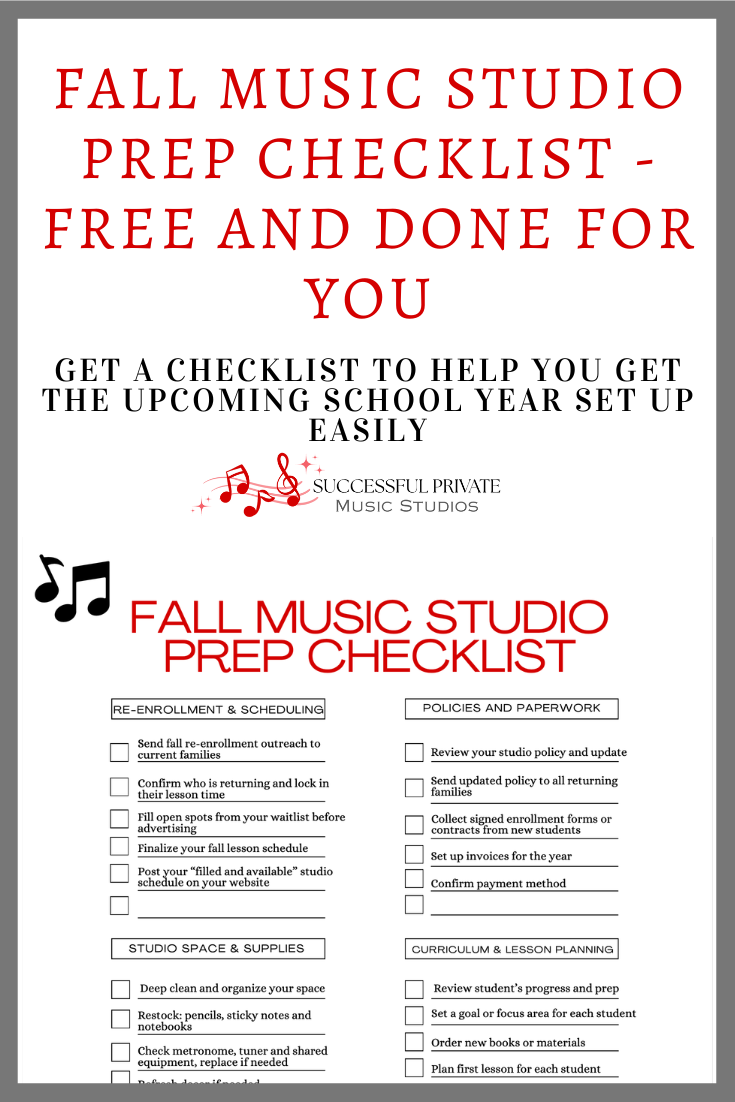
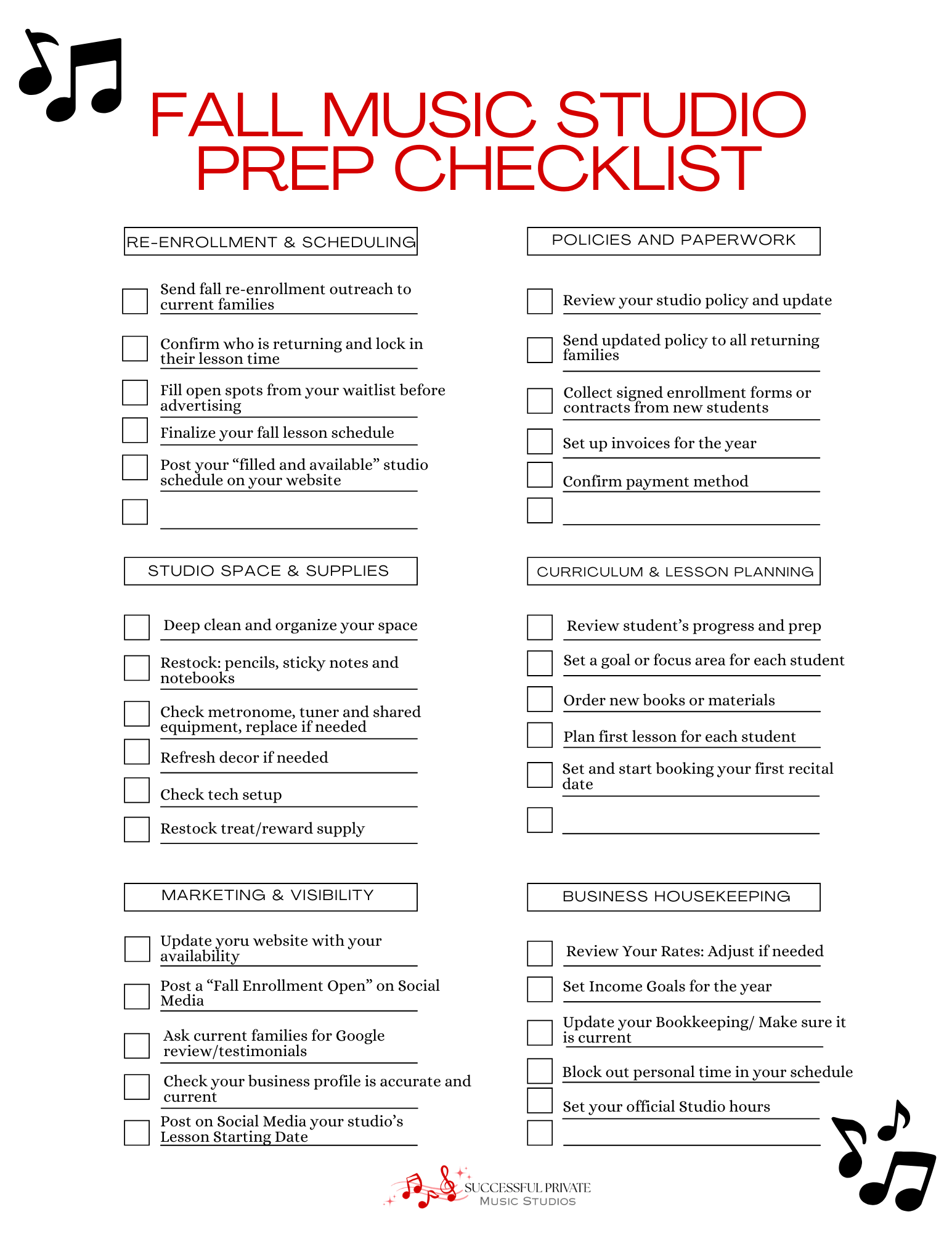
I put together a Fall Music Studio Prep Checklist (you can download the printable version above) that covers all six areas of your studio. Here's a little more detail on each section so you know what to actually do — not just what to check off.
Re-Enrollment and Scheduling
This is your first priority and your most time-sensitive one. Families make fall plans in July and August. If you wait until September to reach out, you'll lose students to schedule conflicts that could have been avoided.
Send a personal note — not a mass email blast — to each current family. Something simple: "We're gearing up for fall and I wanted to reach out before you finalize your schedule. I'd love to have [student name] back this year. Here are the lesson times I have available." That personal touch matters more than most teachers realize.
Once you know who's returning, fill any open spots from your waitlist before you advertise publicly. Your waitlist families have already said yes — they're the easiest enrollment you'll ever get. Confirm every family's lesson day and time in writing before the first week begins. A quick email confirmation prevents a surprising amount of scheduling confusion in September.
Policies and Paperwork
Fall is the natural reset point for your studio policy. Even if you're mostly happy with what you have, read through it with fresh eyes before the new year begins. Did anything cause friction last year — a payment dispute, confusion about makeup lessons, a family who didn't understand your cancellation policy? Fix it now, before it happens again.
Send your updated policy to all returning families for re-acknowledgment. Don't assume they remember what they signed a year ago. And for any new families enrolling this fall, collect signed enrollment forms and get payment set up before the first lesson — not after. Starting the relationship with those logistics in place sets the tone for a professional, well-run studio.
Studio Space and Supplies
Your teaching space sets the tone for every lesson. August is the perfect time to deep clean, reorganize, and refresh before the year begins. I'm not talking about a full renovation — just clearing the clutter, wiping things down, and making the space feel intentional again after a looser summer.
Restock your basics before the first week: pencils, sticky notes, assignment notebooks, and whatever you use for student rewards. Run out of pencils in week two and you'll be annoyed at yourself. Check your metronome, tuner, and any shared equipment — replace anything that's worn out or has dead batteries now rather than mid-lesson in October.
If you teach any online students, test your tech setup completely. Camera angle, audio quality, screen share if you use it, lighting. It all degrades quietly over summer when you haven't been using it consistently. Better to find the problem in August than five minutes before a lesson.
And don't overlook the small stuff: restock your treat bowl, put up a little fall decor, make the room feel like a place students want to be. These things sound minor but they add up to a studio culture that students genuinely look forward to walking into each week.
Curriculum and Lesson Planning
Before fall lessons begin, sit down with your notes from spring and review where each student left off. What were they working on? What was going well? What needed more time? What's the logical next step for each one?
Set a goal or focus area for each student for the fall semester — not a rigid plan, just a direction. "This year I want to focus on building Emma's sight-reading" or "Marcus is ready to start working on an audition piece" is enough. Write it down somewhere you'll actually look at it. Students who are working toward something specific practice more and stay enrolled longer.
Order any new method books or materials now so they arrive before lessons start. And plan your first lesson for each student in advance — don't wing the first week back. A strong first lesson sets the tone for the whole semester.
Set your fall recital date while you're at it. Book the venue early — good spaces fill up fast, especially in November and December. Getting that date on the calendar gives students a goal to work toward from day one.
Need a Studio Policy That Actually Works?
Done-For-You Studio Policy Templates
Stop writing your policy from scratch every fall. These done-for-you templates cover tuition, cancellations, makeups, scheduling, and more — fully customizable in Word or Mac Pages. Includes a tutorial video so you can get it done fast.
Marketing and Visibility
Even if your studio is full going into fall, your online presence still deserves a quick refresh in August. Update your website to reflect your current availability — "fully booked for fall" is actually a great thing to post, because it signals demand and keeps your waitlist growing. If you have open spots, say so clearly and make it easy for families to reach out.
Post a "fall enrollment open" announcement to social media before your schedule fills. A simple post with your instruments, availability, and a clear call to action does the job. You don't need a graphic or a campaign — just a direct, friendly post that tells people lessons are starting.
Check that your Google Business Profile is accurate and up to date. Hours, contact info, website link — all of it. This is what shows up when a parent Googles "music lessons near me," and an outdated listing costs you inquiries you never even know you lost.
While you're at it, ask one or two happy current families for a Google review. The end of summer — when they're thinking about fall and feeling good about returning — is a natural moment to ask. Most families are glad to do it, they just need the nudge.
Business Housekeeping
Fall is also the right time to look at your numbers with fresh eyes. Review your rates — honestly. Have your expenses gone up? Has your market changed? Have you been teaching at the same rate for more than a year without revisiting it? If a rate increase makes sense, communicate it to families in August with enough notice that it doesn't feel like a surprise.
Set an income goal for the fall semester. Not a vague "I want to earn more" — an actual number. How many students do you need at your current rate to hit it? How many open slots do you have? What would it take to get there? Knowing your target changes how you make decisions all semester long.
Update your bookkeeping before the new year starts. Reconcile the summer, make sure everything is current, and go into fall with a clean slate financially. If your bookkeeping system is a mess or nonexistent, that's worth fixing now before you add a full roster of fall students to the chaos.
And finally — block out your own time off before the schedule fills in. Every holiday, every personal commitment, every break you want to take this fall. Put it on the calendar now, communicate it to families in your fall welcome communication, and protect it. You can't run a great studio if you never come up for air.
Work through all six sections over the next few weeks and you'll start September feeling like you're ahead of it rather than chasing it. That feeling carries through the whole semester.
Happy Teaching!
Becky
Want the Complete System Behind a Thriving Fall?
Successful Music Studio Strategies — Signature Course
59 lessons covering re-enrollment strategy, student retention, studio policy, recital planning, marketing, and more — everything you need to walk into every fall fully prepared and fully booked.
$1,250 or 3 payments of $500
Learn More →What do you want to tackle next?
Here are the best next steps depending on where you are right now.
Summer Practicing Tips to Share With Your Music Students (+ Free Printable!)
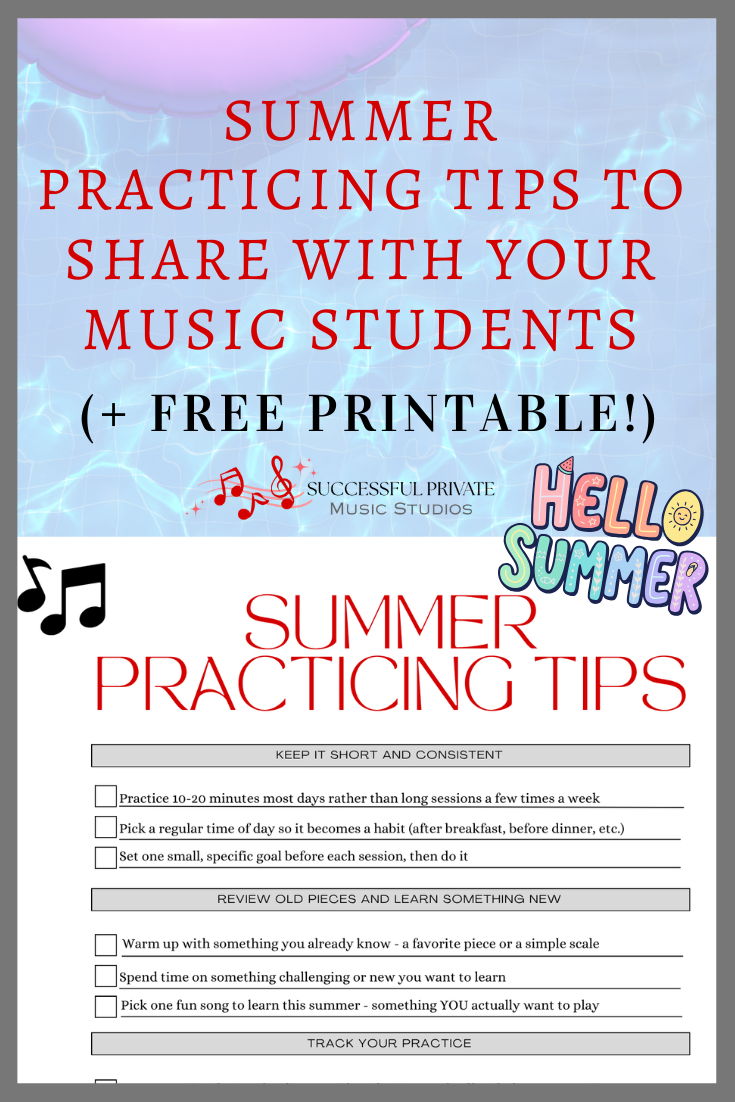
Every music teacher knows the feeling. Students walk back through the door in September and it's like the last three months never happened. Scales are shaky. Songs they had memorized are gone. And you spend the first few weeks of fall just getting back to where you were in June.
It doesn't have to be that way — but it takes a little strategy on your end.
One of the most powerful things you can do before summer break is give your students (and their parents) a clear, simple plan. Not a lecture. Not a guilt trip. Just a friendly guide that sets them up to keep the momentum going while they're out of the routine of weekly lessons.
That's exactly what this post is about. Below are the key summer practicing tips I recommend sharing with your students — organized by category so you can talk through them at the last lesson of the year. And at the bottom, you can grab a free printable checklist to send home with every student.
Why Summer Is Actually a Great Time to Practice
Before we get into the tips, it's worth reframing summer for your students. Regular practicing during break has some real advantages:
No recital pressure. Summer is the perfect time to learn something just for fun.
More flexible scheduling. Without school homework, there's often more space in the day.
Room to explore. Students can spend time on music they love, not just what they're preparing for a performance.
When you help students see summer as an opportunity rather than a break from obligation, they're more likely to sit down at the instrument.
Tip Category 1: Keep It Short and Consistent
The biggest mistake students make over the summer is going all-or-nothing. Either they practice for an hour because they have time... or they don't practice at all because they don't feel like it.
Tips to share with students:
Aim for 10–20 minutes most days rather than long sessions a few times a week. Consistency beats duration every time.
Pick a regular time of day — right after breakfast, before lunch, or after dinner — so it becomes a habit rather than a decision.
Set a small, specific goal for each session. "I will play my scale hands together three times without stopping" is more motivating than "I'll practice."
What to tell parents: Consistency is more important than length. Even 10 minutes a day keeps skills alive. If your child plays for 10 minutes and then wants to keep going — great! But don't require more than that.
Tip Category 2: Review What They Know AND Learn Something New
Students tend to drift toward one extreme: either only playing things they already know (comfort zone) or only drilling the hard stuff (not fun). A balanced session does a little of both.
Tips to share with students:
Spend the first few minutes warming up with something familiar — a piece they've already mastered, a simple scale, or a favorite song.
Then spend time with something new or challenging — a piece they're working toward, a technique they're building, or a song they've always wanted to learn.
Learning a song they actually want to play (a pop song, a movie theme, a piece by a favorite artist) is a great summer project and keeps motivation high.
Teacher tip: Before the last lesson, assign at least one "fun" piece to learn over the summer alongside their regular work. Give them something to look forward to showing you in the fall.
Tip Category 3: Use a Practice Chart
Students do better when there's something to track. A simple practice chart — even just a calendar where they color in the days they practiced — creates a visual record that feels satisfying to fill in.
Tips to share with students:
Put the practice chart somewhere visible: on the fridge, above the piano, or in their lesson binder.
Mark off each day they practice, even if it was just a short session.
At the end of summer, look back at the whole chart. That visual record is genuinely motivating.
You can hand out a blank monthly calendar, a sticker chart, or a simple practice log — whatever matches the age and personality of the student.
New to studio life? Start here.
Need a fast, solid foundation before you hand students anything?
The Music Studio Startup Toolkit is a 65-page resource that covers pricing, policies, branding, and a 30-day roadmap — everything you need to look and run like a professional studio from day one. It's the place to start if you're still building your systems.
Get the Music Studio Startup Toolkit →
One-time · $50 · Instant access · 65 pages
Tip Category 4: Record Yourself
Summer is a fantastic time to start a simple recording habit. Students don't need any special equipment — a phone works perfectly.
Tips to share with students:
Once a week, record yourself playing one piece all the way through. Don't stop to fix mistakes — just play it.
Listen back. What sounds great? What would you fix?
Keep a short playlist of your recordings throughout the summer. By August, you'll be amazed how much you've improved.
This builds self-awareness and listening skills that are hard to teach directly. It's also a wonderful thing to bring to the first fall lesson.
Tip Category 5: Stay Connected to Music (Even Without Practicing)
Life gets busy in the summer. Some weeks, regular practice sessions may not happen — and that's okay. Students can still stay connected to music in ways that matter.
Tips to share with students:
Listen to music intentionally. Listen for the instrument you play. Notice the rhythm, the melody, the dynamics.
Watch a live performance on YouTube — an orchestra concert, a soloist, a band. It's surprisingly inspiring.
Attend a local concert if the opportunity comes up.
Hum or sing through a piece you're learning, even without the instrument in front of you.
Staying connected to music mentally keeps students in the mindset of a musician, even during a lighter practicing week.
Free Printable: Summer Practicing Tips Checklist for Students
To make it easy to share these ideas with your students, I've put together a clean, print-friendly one-page checklist summarizing the key tips above.
It's simple, student-friendly, and designed to be sent home at the last lesson of the year — or emailed to families along with your end-of-year studio newsletter.
The checklist includes:
Short, student-readable tips organized by category
A section for students to write their own summer practice goal
A reminder of the first day back for lessons (you can fill this in!)
It's the kind of thing that costs you almost nothing to share, but shows your families that you're invested in their progress even when lessons aren't in session.
Get your free Summer Practicing Tips Checklist →
Sign up below and I'll send it straight to your inbox.
[First Name] [Last Name] [Email Address] [Submit]
No spam. Just practical tools and tips to help your studio thrive.
A Few Final Words for Teachers
Handing out a tip sheet doesn't replace the conversation — it reinforces it. Take 5 minutes at your last lesson of the year to talk through the summer plan with your student. Ask them what piece they want to learn. Help them set one specific goal. Make it feel like a challenge they're excited about, not homework they have to do.
The students who come back in the fall having maintained their skills aren't necessarily the most talented — they're the ones who had a clear plan and a teacher who set them up for success.
You're already doing that just by being here.
Happy Teaching!
Becky
What do you want to tackle next?
You've got the tips — here are the best next steps depending on where you are right now.
Freshen Up Your Spring Recital: Free Premade Templates to Wow Your Audience
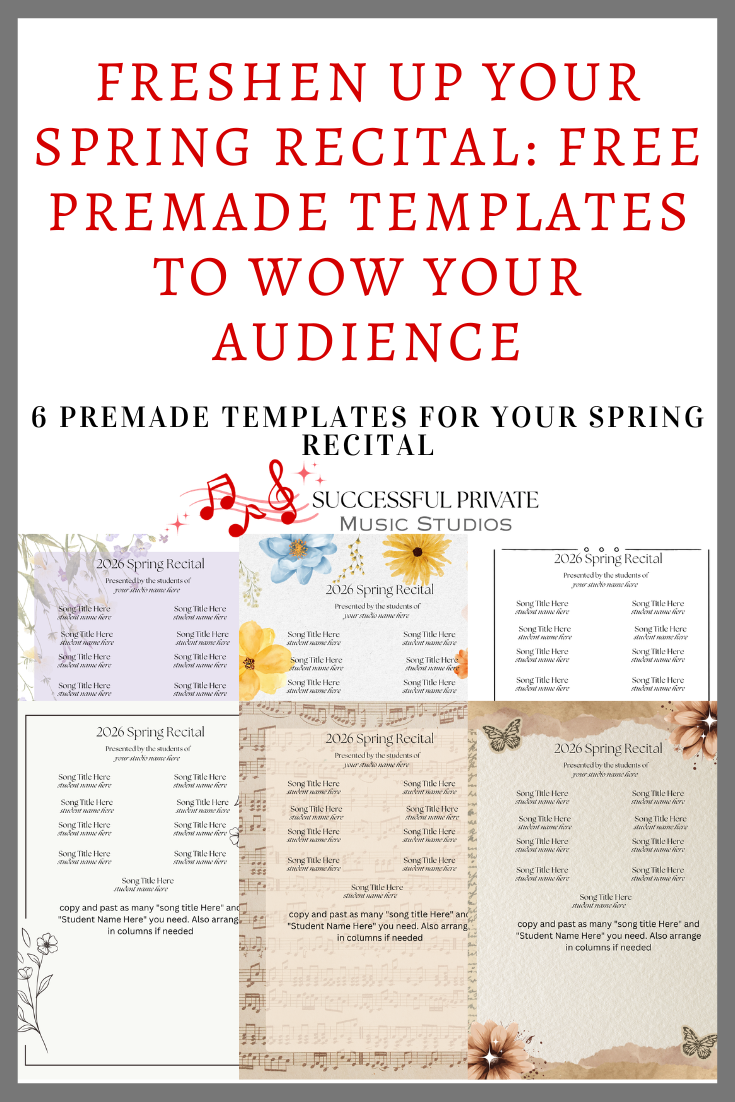
Spring recital season is one of the most exciting times of the year for music teachers and studio owners. It’s a chance to celebrate your students’ growth, bring families together, and create a memorable event that reflects the heart of your studio. But let’s be honest—recital prep can also be a lot.
Between organizing programs, designing certificates, creating signage, and making everything look cohesive, the hours add up fast. That’s exactly why premade templates are a lifesaver. They give you a polished, professional look without the stress of designing everything from scratch.
This year, I’ve put together a fresh collection of free spring recital templates to help you elevate your event with ease. Whether you’re hosting a small studio showcase or a full‑scale performance, these templates will help you stay organized and impress your audience.
I’ve made it super simple. Just fill out the form below, and you’ll get instant access to the full set of spring recital templates. They’re completely free and ready for you to start customizing today.
Fill out the form below to download your templates and start planning your most beautiful spring recital yet.


I’m Becky and Welcome To Successful Music Studio Strategies where I help you create your own Successful Private Music Studio business through simple strategies I’ve learned and used in my own successful private music studio! Want to learn more about my online courses to help you start, build and create a successful and THRIVING music studio? Click here!