

Post Categories: What do you need help with?
Starting Your Studio
Keep Your Studio Running
Making Your Studio Thrive
🎃 The Holiday Practice Challenge Is Here — Two Years of Challenges, Zero Repeated Content
October is closer than it feels. And if you've ever hit week three of November wondering why half your students clearly haven't touched their instrument since the last lesson — you already know what the holiday slump looks like.
Schedules go sideways. School events pile up. Sports and family obligations compete with practice time. By Thanksgiving, the students who were doing so well in September have quietly checked out.
The Holiday Practice Challenge is the system that changes that — and this fall, it's bigger than ever.
🎃 What Is the Holiday Practice Challenge?
The Holiday Practice Challenge is a done-for-you, print-and-go practice system that carries your students from Halloween through Winter Break. Each kit includes:
Three monthly practice charts with seasonal designs for October, November, and December
A color-by-number practice chart students actually want to fill in every day
11 weekly bonus challenge cards — each with a technical task, a creative challenge, and a listening activity
A prize basket raffle system that gives students a concrete reason to bring their challenge cards to every lesson
A sticker chart template customizable for your entire studio roster
Clear challenge rules and how-it-works instructions for you and your families
You open the download, print everything, and hand it out at the first October lesson. That's the entire setup.
🍂 What's New This Year — Meet Set 2
Set 1 has been running in studios for a year now, and the response has been genuinely wonderful. Students coloring in their charts. Parents texting that their kids are asking to practice. Lessons filled with conversations about the weekly bonus challenges.
This fall, Set 2 launches — and it is a completely fresh second year.
Not a tweak. Not a light refresh. Every single weekly challenge theme, technique task, creative prompt, and listening activity is brand new. A student who ran Set 1 last year will never see a repeated challenge in Set 2. Not one.
Here's a side-by-side look at just October:
Week 1: Haunted House (Set 1) vs. Whispering Scales — E Harmonic Minor pianissimo (Set 2)
Week 2: Skeleton Dance (Set 1) vs. Phantom Rhythm — dotted rhythms with Long/Short pattern (Set 2)
Week 3: Pumpkin Parade (Set 1) vs. Shadow Steps — silent hand shifts between positions (Set 2)
Week 4: Spooky Sounds (Set 1) vs. Echo Etudes — compose a 2-bar echo motif (Set 2)
Week 5: Halloween medley listening (Set 1) vs. Haunted Harmony — g minor chord progressions and perform in costume (Set 2)
November and December are equally fresh — new themes, new challenges, new creative tasks all the way through.
Already Have Set 1? Here's Set 2
If you ran Set 1 last year and your students loved it — welcome back. Set 2 is ready for you.
Same system your students already know. New challenges they've never seen. You don't have to explain anything new — just hand out the October chart on the first lesson and they'll take it from there.
If you already own Set 1 and want to add Set 2 at a loyalty price, reach out directly and we'll work something out.
❄️ The 2-Year Bundle — Two Sets, One Download, Save $15
If you want to run the Holiday Practice Challenge for the next two years without ever repeating content, the 2-Year Bundle is the move.
Both sets in one download. Run Set 1 this year, Set 2 next year. Your students get a fresh challenge every fall, you never have to buy anything new, and you save $15 compared to buying them separately.
Here's what that looks like in practice:
Year 1: Your students run Set 1. They love the Haunted House scale challenge, the Gratitude Groove arpeggios, the Carol Countdown. They ask if you're doing it again next year.
Year 2: You hand out Set 2. Every challenge is brand new. Whispering Scales. Apple Arpeggios. Circle of Sound. They have no idea it's the same system — it just feels fresh.
Twenty-two total weekly challenges. Six monthly practice charts. Zero repetition. One $60 purchase.
One Final Thought
October comes fast. The challenge works best when students start from day one of the month — so the earlier you get set up, the more impact you'll see.
If you're new to the Holiday Practice Challenge, start with Set 1 and see what it does for your studio this fall. If you loved last year and want two years locked in, grab the bundle now and you're done.
Either way — your students are going to walk into that first October lesson with a reason to practice every single day.
Happy Teaching!
Becky
4 Things to Do This Summer to Reset, Refresh, and Prep Your Music Studio for Fall
For most music teachers, summer looks like a mix of lighter lessons, a little breathing room, and — if we're being honest — a pile of studio tasks that have been quietly building since January.
But summer isn't just a slower season. It's your best window of the year to work on your studio instead of just in it. A few intentional hours between now and back-to-school can mean the difference between a chaotic September and one where you walk in knowing exactly where you stand — fully booked, organized, and ready.
Here are four things I do every summer to reset, refresh, and set my studio up for a strong fall.
1. Reset Your Studio Space
Before anything else, I do a physical reset. Whether you teach in a dedicated studio room, a corner of your home, or at students' houses, things accumulate over a school year. Sheet music gets shuffled. Supplies run low. That one stack of papers you've been meaning to sort since March is still sitting there.
Summer is the time to deal with it.
Go through your teaching materials and pull anything you're no longer using. Restock the supplies that ran out — pencils, sticky tabs, practice charts, whatever you reach for regularly. If you have a waiting area, a whiteboard, or any student-facing space, freshen it up. A clean, organized environment affects how you feel when you walk in to teach — and students and parents notice it too.
This doesn't have to take a whole day. Even two focused hours can transform a cluttered space into one that feels intentional and professional.
2. Update Your Templates and Studio Documents
This is the quiet administrative work that pays off all year. Just like the year-end Great Reset, summer is a natural time to review and refresh the core documents your studio runs on.
Work through this list before fall:
Lesson summary templates — update any dates or headers, make sure the format still works for how you teach
Payment receipt templates — confirm your rates are reflected accurately, especially if you raised them
Welcome packets or new family handouts — anything a new student would receive on day one
Studio policy — read through it with fresh eyes. Does it still reflect how you actually run your studio? Are there gaps or situations from last year that your policy didn't cover?
That last one catches most teachers off guard. Policies tend to get written once and forgotten — until a situation comes up that your policy doesn't address. Summer is the time to close those gaps, before a new family walks through the door expecting clear answers.
Done-for-You Templates
Successful Music Studio Policy Templates
If your policy needs more than a quick edit — or you don't have one yet — these customizable templates cover tuition, cancellations, scheduling, communication, and more. Includes a tutorial video and lifetime access.
Adds income growth, student retention, and referral sections.
3. Prep for Fall Enrollment
This is the one that makes the biggest difference in how September feels — and it's the step most teachers either skip or leave too late.
Here's how I handle it: by the end of July, I reach out to every existing family to confirm whether they're returning in the fall and to lock in their lesson time. I don't wait for them to reach out to me. I initiate the conversation, get a commitment, and put it on the schedule.
Why does this matter? Because by the time school starts, I know exactly where I stand. I know which spots are filled, which are open, and how many new students I have room for. There's no guessing. No last-minute scramble. No September where I'm still trying to figure out my schedule while also teaching 20 lessons a week.
A simple reach-out message goes a long way. Something like: "Hi! I'm getting the fall schedule set up and wanted to reach out early to lock in your regular lesson time before spots fill up. Are you planning to continue in the fall?" That's it. Short, warm, and it creates a gentle sense of urgency without pressure.
From there, keep a running list — returning students confirmed, returning students pending, open slots. Update it as responses come in. By the first week of August, you'll have a clear picture of where you need to focus your enrollment energy.
If you have openings, now is also the time to let people know. A quick social media post, a note in your studio newsletter, or even just word-of-mouth through current families can fill spots before the school year even starts.
Just Getting Started?
Music Studio Startup Toolkit
If you're launching a new studio this fall, this is your starting point. A 65-page framework covering your business plan, pricing, branding, policy basics, and a full 30-day launch roadmap — so you walk into September with a real plan, not just a hope.
$50 · one-time · instant download
Get the Toolkit →4. Set Your Goals for the New Studio Year
The school year start is a natural reset point — and it's the perfect time to decide, intentionally, what you want this year to look like.
Not in a vague "I want to do better" way. In specifics.
How many students do you want to have by October? What's your monthly income target? Is there one thing about how you ran your studio last year that you want to change — a policy you never enforced, a schedule boundary that didn't hold, a recital you want to do differently?
Write it down. Even three clear goals for the year gives you something to come back to in January when things feel overwhelming, or in May when you're deciding whether to add a student or hold your ground on a boundary.
Some questions worth sitting with:
Did I end the school year at the income I wanted? If not, what needs to change?
Were my studio policies working, or did I make exceptions that cost me time and energy?
What's one thing I want to add, improve, or let go of this year?
This doesn't require a long planning session. Thirty minutes with a notebook and a cup of coffee will do it. What matters is that you enter September with intention — not just momentum.
Summer is short, and it goes fast. But a few focused hours now means you walk into fall with a full schedule, a clean studio, updated systems, and a clear direction. That's not just organization — that's confidence.
Happy Teaching!
Becky
Keep the momentum going
What do you need next?
⭐ Start Here
🗺️ Launch Your Studio This Fall
Startup Toolkit · $50 · Business plan, pricing, branding & 30-day roadmap →
📄 Get Your Studio Policies Set
Done-for-You Policy Templates · from $125 · Ready to customize →
🎓 Build a Studio That Runs Like a Business
Signature Course · 59 lessons · Everything to launch & grow →
🗺️ Not Sure Where to Start?
Free · 2 minutes · Start Here page →
Done For You - Spring Practice Challenge Kit
🌸 Introducing the Spring 2026 Practice to Performance Challenge: A Done For You Path to Confident Spring Recital Performances
Spring recital season is right around the corner, and if you’re anything like most music teachers, you’re already thinking about how to keep your students practicing consistently in the weeks leading up to it. That’s exactly why I created the Practice to Performance – Spring 2026 Teacher’s Kit — a complete, zero‑prep practice challenge designed to guide your students from early‑spring warm‑ups to confident recital‑day performances.
This 15‑week challenge gives you everything you need to support steady, purposeful practice without adding anything extra to your plate. Whether you run it with your entire studio or offer it to individual students, you’ll have a clear, structured system that keeps everyone moving forward.
Start Date for the Kit is February 2 and goes until May 15
🎶 What’s Inside the Teacher’s Kit
The Spring 2026 Practice Challenge includes:
• 15 weekly themed pages with a Technical Challenge + Creative Challenge
• Student practice charts for tracking daily progress
• Coloring pages to keep younger students motivated
• A studio‑wide sticker chart to build community and excitement
• Teacher instructions to help you roll it out with ease
• A video walkthrough so you can see exactly how to use the kit in your studio
Everything is organized, ready to print, and designed to help your students build habits that last.
🌱 Why This Challenge Works
The structure of the challenge follows a natural arc from February through May, helping students:
• Start strong with simple, engaging weekly goals
• Build consistency through daily practice tracking
• Sustain motivation with creative activities and visual progress
• Thrive on recital day with pieces that feel polished and confident
Teachers love that it’s completely plug‑and‑play. Students love that it’s fun, colorful, and easy to follow. And studios love the sense of momentum it creates.
🎉 Now Available for Spring 2026
You can now access the full Practice to Performance – start preparing your studio for a smooth, successful recital season. If you’ve been looking for a way to keep students practicing with purpose — without adding hours of planning to your week — this kit was made for you.
Let’s make this spring your most confident, consistent, and joyful recital season yet.
FREE 2025 Pre-Made Holiday Themed Canva Recital Program Templates
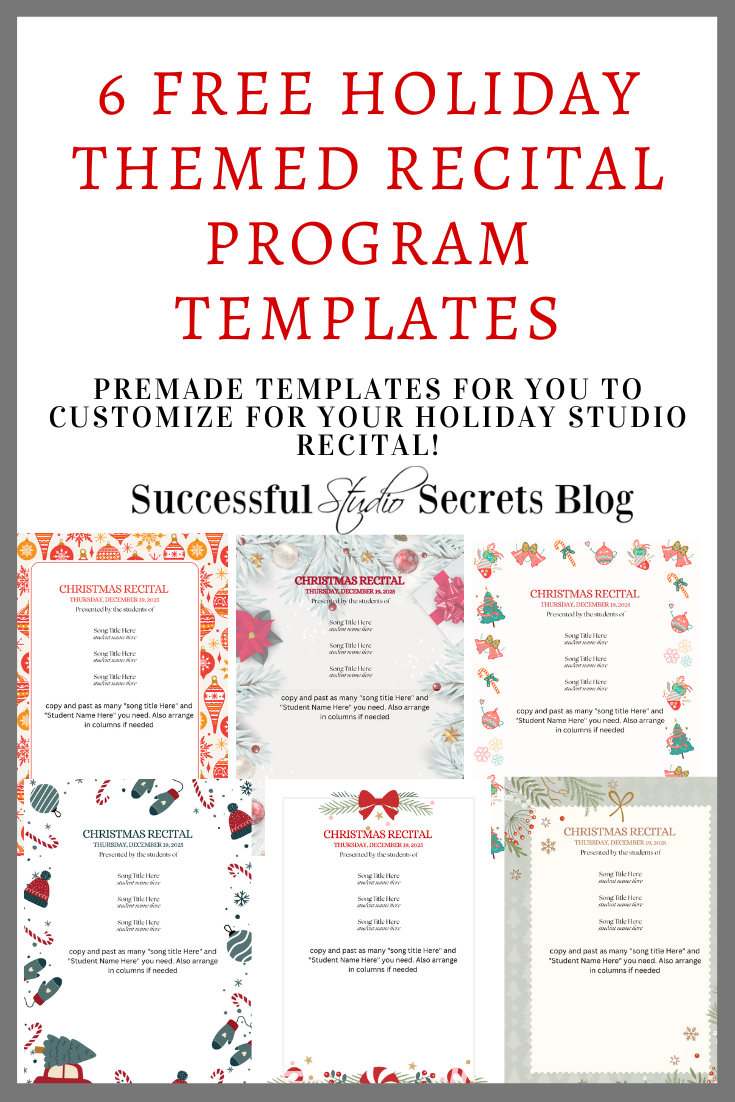
Need help with a quick and easy recital program? I made 6 different Holiday Themed Recital Program Templates this year, you can use them using Canva.com. (not paid or advertising, just an actual service I use.)
You can create a FREE ACCOUNT to get access, and be sure to save the templates to your account before you make changes so everyone can access them as they are now.
Happy Teaching!
Becky
Free Spring Recital Templates to Make Your Music Event Shine

Need help with a quick and easy recital program? I made 6 different Spring Themed Recital Program Templates you can use, using Canva.com.
You must create an account to access, and be sure to save the templates to your account before you make changes so everyone can access them as they are now.


I’m Becky and Welcome To Successful Music Studio Strategies where I help you create your own Successful Private Music Studio business through simple strategies I’ve learned and used in my own successful private music studio! Want to learn more about my online courses to help you start, build and create a successful and THRIVING music studio? Click here!