

Post Categories: What do you need help with?
Starting Your Studio
Keep Your Studio Running
Making Your Studio Thrive
Rest Notes and Refresh: Why Summer Breaks Can Be Helpful for Private Music Teachers

In the world of private music teaching, it’s easy to feel like you’re always "on stage." Each lesson demands focus, warmth, and high-level guidance—and over time, that can wear even the most passionate instructor down. That’s why building a purposeful summer break into your studio calendar isn’t indulgent—it’s essential. I personally take 10 weeks off, but that is because I have my 3 kids home with me all day, every day. And balancing that family life, keeping my own kids entertained and a regular teaching schedule and balancing summer vacations just doesn’t work for our family right now.
🎼 The Harmony of Taking a Break
A summer slowdown is about more than just catching your breath:
Preventing Burnout: Teaching music is deeply rewarding, but it’s also emotionally and mentally intensive. A seasonal pause helps you refuel, both personally and creatively.
Reorganizing Systems: Summer is a prime time to refine scheduling practices, revamp policies, declutter studio materials, or upgrade technology.
Researching & Reinvigorating: With fewer lesson hours, you can experiment with new repertoire, explore fresh teaching methods, or deep-dive into pedagogy books that spark new ideas for fall.
📯 The Trade-Offs to Consider
Taking time off also requires strategy, especially when your studio is your livelihood:
Income Gaps: A full summer break can interrupt your cash flow. To prepare, consider:
Spreading tuition over 12 months.
Establishing a summer-specific savings cushion.
Offering prepaid summer lesson packages or digital resources.
Retention Risk: If you pause completely, some students may drift away or seek other options. Clear communication, early scheduling, or offering a light-touch summer program can help maintain continuity or even a midsummer break get-together. Ice cream social with a mini group lesson attached to it.
🎶 Flexible Summer Rhythms That Work
You don’t have to choose between full throttle and complete silence. Try one of these tuned-down alternatives:
Teach every other week: Offers Balance - Students stay engaged and you still get rest and time to recharge
Teach 1 month in the summer like July while taking June and August Off: A clean end, start, reset rhythm that honors both momentum and downtime
Offer Camp Style Intensives: One or two theme weeks with group or private sessions- great for scheduling and income
Go Lighter, not silent: Offer fewer lesson slots or switch to virtual check-ins to check on their progress. Aim to send an email at least 3 weeks BEFORE you start teaching to confirm lesson times with your students and to see how many, if any, openings you have for the next school year.
🎹 No Break? No Problem—Teaching Through the Summer
For some studio owners, pausing during the summer simply isn’t practical—or even desirable. Maybe you love the consistency, rely on the income, or find joy in helping students make progress year-round. Teaching through the summer can absolutely work, especially with a few thoughtful adjustments:
Shift the Focus: Consider relaxing your regular curriculum to allow for creative detours—like student-led projects, fun repertoire, or theory games.
Adjust Expectations: Lighter attendance and vacation schedules can make summers feel more flexible. Use this time to encourage casual learning and exploration.
Capitalize on Availability: Students often have more free time in summer, which can lead to more focused practice, lesson intensives, or scheduling flexibility.
Build Momentum: For newer students or beginners, continuing lessons keeps their progress steady and helps build strong foundational habits.
The key is to communicate clearly with families about your summer policies in your studio policy and remind them early in the spring, so they know what to expect and can plan accordingly.
At its best, summer becomes a beautiful fermata—a pause, yes, but full of intention and grace if you choose to take a summer brek. Whether you fully rest or shift into a lighter tempo or keep going, planning your summer can protect your artistry and your business in the long run. Plus it’s your studio, you get to make the rules.
So take a breath. Reset your rhythm. Your studio (and your sanity) will thank you.
Happy Teaching!
Becky
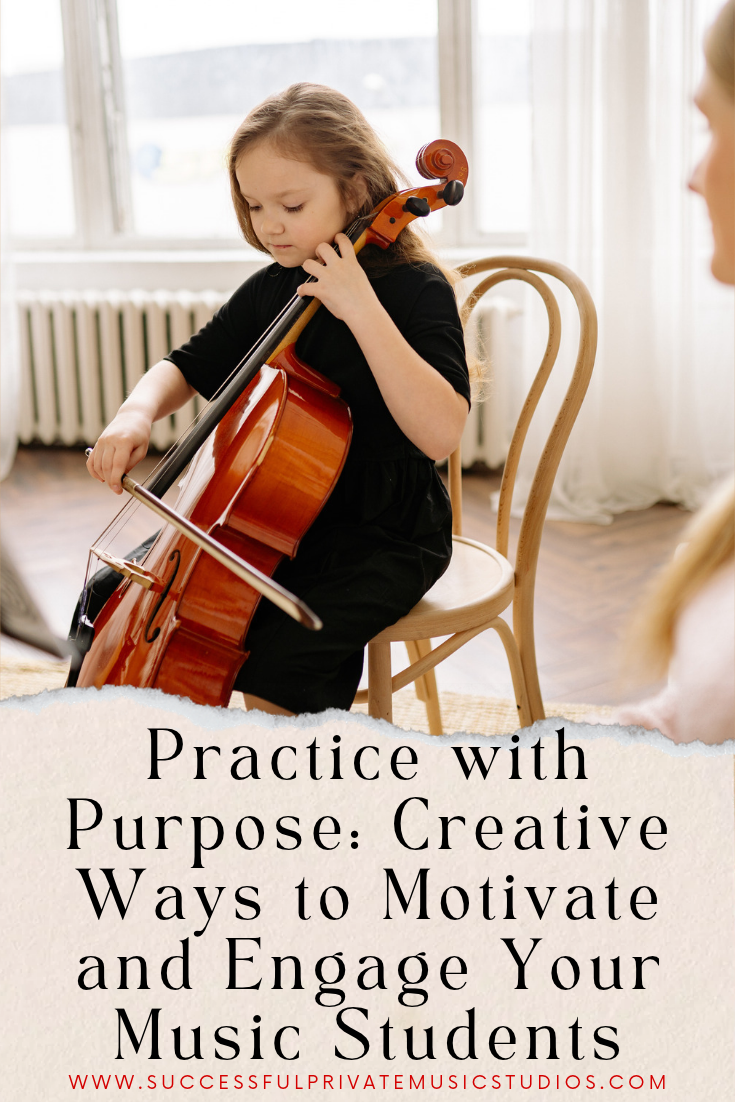
Practice with Purpose: Creative Ways to Motivate and Engage Your Music Students

Practicing is the cornerstone of musical progress — but keeping students motivated to actually do it consistently is one of the biggest challenges in private music teaching.
The good news: motivation isn't something students either have or don't have. It's something you can build, shape, and sustain with the right strategies in place. When students practice with purpose and enthusiasm, they make meaningful progress and develop a genuine love for music that outlasts their time in your studio.
Here are six ways to make practicing something your students actually want to do.
1. Gamify the Practice Experience
Games work because they make effort feel rewarding in real time — and that's exactly what consistent practicing needs.
Weekly and monthly challenges. Create structured challenges with a clear goal: master a tricky passage, play a piece correctly three times in a row, or practice every day for two weeks. Pair the challenge with a small tangible reward — a sticker, a certificate, a choice of repertoire for the next lesson — and watch how quickly students start tracking their own progress.
Visual progress charts. There's something uniquely satisfying about filling in a chart. A simple weekly practice log where students color in each day they practiced gives them a visual record of their own consistency. Over time they'll start competing against themselves.
Practice Bingo. Design a bingo card with specific practice tasks: "Play the whole piece from memory," "Practice hands separately for 10 minutes," "Record yourself and listen back." Completing a bingo earns a reward. Students who would resist a plain practice assignment will enthusiastically pursue the same work when it's framed as a game.
A done-for-you practice challenge — complete with tracking tools, student materials, and everything you need to run it in your studio — is exactly what the Practice Challenge Kits are designed for.
Done-for-You Practice Challenge
Holiday Practice Challenge Kit
A completely done-for-you practice challenge — structured daily goals, a visual tracker, and everything you need to keep students consistent and motivated. Just print and hand out. Perfect for keeping students on track through the holiday season when consistency is hardest to maintain.
Get the Holiday Challenge Kit →2. Personalize the Journey
Every student is unique — and the fastest way to kill motivation is to make practice feel generic.
Let students choose their repertoire. When students are working on music they actually love, practicing stops feeling like homework. Ask them what they're listening to, what songs they wish they could play, what musicians they admire. When possible, work those preferences into their repertoire. A student who is practicing because they want to play their favorite song is a completely different kind of student than one who is working through the next page of a method book because you assigned it.
Creative assignments. Encourage students to compose a short original piece, write their own variation on something they've learned, or arrange a simple melody they know. Creative work builds a personal relationship with the instrument that assigned pieces alone can't replicate.
Student-driven goals. Let students name what they're working toward — a specific piece, a technique, a performance. When the goal is theirs, the motivation to reach it is theirs too. Check in on those goals at lessons and celebrate when they hit them.
3. Incorporate Technology
The tools your students are already using in the rest of their lives can make practice more interactive, more trackable, and more fun.
Practice apps. Apps like Tonara, Piano Maestro, and Simply Piano provide real-time feedback, progress tracking, and built-in rewards that make practicing feel like a game. For younger students especially, these apps can bridge the gap between lesson time and home practice in a way that a plain practice log can't.
Recording sessions. Have students record themselves playing their current piece — just on a phone, nothing fancy. Listening back does two things: it helps them hear things they miss while playing, and it gives them a tangible record of their own progress over time. A student who can compare a recording from September to one from December has a powerful source of motivation that no amount of encouraging words can replicate.
Virtual collaborations. Pair students for online duet sessions, virtual recital prep calls, or recorded performances they can share with family. When students know someone else will hear them play, their relationship with practicing changes entirely.
Keep Your Studio Running Smoothly
Part 2 — Keeping Your Studio Running
Student motivation, practice systems, parent communication, scheduling, and the organizational strategies that keep your studio running smoothly week after week. Everything you need to keep your studio consistent and your students engaged.
$500 · lifetime access
Get Part 2 →4. Celebrate Achievements
Recognition is one of the most powerful — and most underused — motivators in private music teaching.
Practice awards. Hand out simple awards for consistency, improvement, or creative effort. It doesn't need to be elaborate — a printed certificate, a sticker, a special mention at the next lesson. The act of being recognized publicly for effort creates a positive association with the work that led to it.
Showcase their progress. Create regular opportunities for students to share what they've learned — recitals, studio showcase nights, even short performance videos for families. When students know their practicing is leading toward something they'll perform, the practice itself feels purposeful rather than arbitrary.
Celebrate milestones. When a student finishes a method book, masters a challenging piece, or hits a personal goal they set themselves — make a moment of it. These milestones matter. Acknowledging them tells students that their effort was seen and that progress is worth celebrating.
5. Foster a Growth Mindset
How students think about their mistakes has a bigger impact on their progress than almost anything else you teach them.
Praise effort, not just results. "You worked really hard on that section today" lands differently than "that was perfect." Students who are praised for effort learn to value the process of getting better — which is exactly the mindset that leads to consistent practicing.
Teach them how to practice, not just what to practice. Most students who don't practice consistently aren't lazy — they don't know what to do when they get stuck. Teach them to isolate the hard measure, slow it down, practice it three times correctly before moving on. Give them a strategy they can use independently and they'll practice with far more confidence.
Keep it joyful. Music is about expression and enjoyment. When a student is visibly frustrated, sometimes the best thing you can do is set the assignment aside and just play something fun together. A student who leaves a lesson feeling good about music is more likely to sit down at the instrument before next week than one who leaves feeling defeated.
6. Get Families Involved
The most consistent practicers almost always have a parent who is engaged, informed, and present.
Invite parents into practice time. Encourage parents to be present during home practice — not to correct or direct, but just to listen. A child who is performing for their parent practices differently than one who is alone in a room. Even five minutes of "can you play that for me?" from a parent changes the dynamic entirely.
Practice logs with parent notes. Provide a simple weekly practice log with a column for parents to leave observations or encouraging notes. This keeps parents connected to what their child is working on and signals that practicing is a shared family priority, not just a school assignment.
Informal home performances. Encourage students to play for family members at home — grandparents, siblings, family friends. These low-stakes performances build performing confidence in a way that formal recitals can't fully replicate, and they give students a reason to prepare something they're proud of.
Engaging students in consistent, purposeful practice doesn't happen by accident — but it also doesn't require a complete overhaul of how you teach. Start with one strategy from this list. Try it for a month. See what shifts.
The goal isn't perfect practice every week. The goal is a student who has a genuine, personal relationship with their instrument — one that outlasts their lessons with you and lasts a lifetime.
Happy Teaching!
Becky
Ready to Build a Studio That Runs Like a Business?
Successful Music Studio Strategies — Signature Course
Student motivation, practice systems, parent communication, recitals, policies, bookkeeping, income growth — the Signature Course covers all of it across 59 lessons. The complete roadmap for building a thriving private music studio.
$1,250 · or 3 payments of $500
Learn More →Keep the momentum going
What do you need next?
⭐ Most Relevant
🎄 Holiday Practice Challenge Kit
Done-for-you · Keep students on track through December →
🌸 Spring Practice Challenge Kit
Set 1 · $37.50 · Done-for-you · Spring recital prep →
🎓 Keep Your Studio Running
Part 2 Course · $500 · Systems, motivation & retention →
🗺️ Not Sure Where to Start?
Free · 2 minutes · Start Here page →
5 Secrets to Skyrocket Student Retention in Your Music Lessons

Keeping students engaged and excited about lessons and practicing is one of the challenges teachers face in retention for lessons. If the student isn’t having fun, they won’t want to practice; lessons become challenging because you, the teacher, have to reteach the previous lesson, and you can’t accomplish what needs to be done in the lesson and the student doesn’t make the progress they are hoping for. To help combat this cycle, here are 5 secrets to Skyrocket your Student Retention.
1) Give A Little:
Have a fun studio atmosphere. Be a little less formal than the teachers were a couple of decades ago. Play music online for them. Have them bring in the music they want to do. Talk about their favorite music and see if you can find sheet music just for that as a “fun song”.
2) I Am Not Above Bribery.
Candy is sometimes the best incentivizer. I like to have a bowl of candy in eyeshot of the students during their lesson and allow them to pick from AFTER their lesson. They only get the candy at the end. And you better believe they are thinking about what candy they want to pick from the bowl for most of the lesson.
3) Make Practicing and Assignments Fun.
Have fun activities for them to work towards. Create a sticker chart where students can earn prizes for practicing or completing assignments in their theory workbook or other outside assignments.
4) Embrace Holidays.
Use holidays to decorate your studio space, and special candy or themed activities year after year so students know what to expect and look forward to each year.
5) Get The Whole Studio Together!
Offer group classes, or performance classes where students can practice performing for other’s in a safe space, but also allows them to meet other students in the studio. Never hurts to have a short pizza or ice cream party afterward too!
Happy Teaching!
Becky
Unleash Your Inner Musician: How Teaching Private Music Lessons Can Take Your Musicianship to the Next Level

There’s one thing to be able to do something, but teaching others, that’s a whole new ball game. I remember when I decided to start teaching, I literally sat down at my piano and thought, “how the heck did I learn how to do this?” Because, I don’t really remember the first few years of learning. It was just something I went to and didn’t become an enjoyable passion until I was in 7/8th grade. By being a teacher you have to internally reflect and always learn changing ways to help students excel.
You have to learn how to explain musical concepts and techniques clearly to your students. And as it’s an ever growing and learning experience you will develop new techniques over time as you evolve as a teacher. Don’t feel boxed in that you have to teach a specific way. Create what works for you that conveys the proper information.
Sit at your instrument and work through it. How did I learn to play this? How do I do this? When did I learn scales or other techniques? How do I show someone how to…The list goes on.
Plus don’t just sit with your instrument thinking, you have to lead by example. Rework your own technique. Sit down and drill out those scales. Revisit some old songs you learned back in the day. How can you improve them now. Or learn a new song or 2. Just start back into your own playing.
Is there an organization you can participate with? A music club, community ensemble, band, choir, orchestra. Join those groups for the experience of rehearsing and performing on a regular basis.
🎶 Each teacher will have their own style in how they present ideas. Some people refer to “ C” as home note, or the C scale. For my younger kids I teach positions before I teach pentascales or full scales. We call it C Position, “CPOS” or Middle C Position “MCP” (when the thumbs are sharing middle C) and as the student progresses I teach the full meanings terminology. Your goal is to create terms that work best for your students.
Remember, your goal as the teacher is to teach as much as you can in the time you have available. Each student is going to learn differently and you have to lean into that as a teacher. Just keep trying new ways that work for you and your students.
Happy Teaching!
Unlock the Musician Within: How to Incentivize Music Practicing and Boost Your Student's Skills

Practicing. Most people don't love it — and honestly, I didn't love it all that much growing up either.
I compare practicing to working out. We know we need to do it. We know it's the only thing that actually makes us better. But knowing something and actually doing it consistently are two very different things — and that gap is where most students get stuck.
For adults, the challenge is time and motivation. For kids, it's a little more straightforward: they need structure, accountability, and a reason to care. Here are the strategies I use in my own studio — and with my own child — to make consistent practicing happen.
1. Personal Incentives — Let the Student Find Their "Why"
The most powerful practice motivator isn't a reward you create as the teacher. It's the one the student finds on their own.
In my house, my own child knows he can't go out to play with friends until he's done practicing. That external rule eventually turned into an internal habit — he started practicing before his daily reminder even went off because he wanted to get outside faster. He essentially created his own incentive system.
The key is working with parents to figure out what their child genuinely cares about. Is it screen time? Playing with friends? A specific activity after school? Once you know what motivates a student, help the family build a simple "practice first, then reward" structure around it.
Talk to parents at enrollment and again any time practice consistency starts slipping. Ask: what does your child really look forward to each day? That's where the leverage is.
2. Sticker Charts — Simple, Visual, and It Works
Don't underestimate the power of a sticker chart, especially for younger students. There's something about seeing tangible evidence of progress that keeps kids coming back.
Sticker charts work on a simple principle: results-based reward. "If I do this, I earn that." Over time students start to connect consistent practicing with forward progress — and that connection is one of the most valuable things a young musician can internalize.
Keep it simple. A weekly chart with their pieces listed and a sticker for each day they practiced is enough. The stickers themselves don't need to be fancy — the act of marking the chart is the reward.
In my studio I run a Practice to Performance Challenge every spring — a structured, studio-wide practicing incentive that builds consistency and momentum leading up to the spring recital. Students love having a shared goal to work toward together.
Done-for-You Student Resource
Spring Practice Challenge Kit — Set 1
Run a structured, motivating practice challenge in your studio without building it from scratch. This done-for-you kit has everything you need — just print, hand out, and watch your students show up more prepared every single week.
$37.50 · instant download
Get the Spring Kit →3. The Candy Bowl — Old School, Still Works
Sometimes the simplest systems are the most effective. A bowl of candy in your studio for students to take at the end of each lesson is a small but surprisingly powerful motivator — especially for younger students.
The key is to attach rules to it so it ties directly to practice behavior. A student who had a great lesson and practiced consistently the week before gets to take an extra piece before they leave. A student who didn't practice gets the standard one — no shame, no lecture, just a clear and consistent difference in reward.
Over time students notice. And more importantly, they start to connect effort with outcome in a very direct, tangible way.
You can adapt this to whatever fits your studio culture — a treasure box, a points system, a punch card for small prizes. The medium matters less than the consistency of the connection between practicing and reward.
4. Give Students Something to Perform Toward
One of the most effective long-term practice motivators is a performance date on the calendar.
When students know they'll be performing — whether at a full recital, a small studio class, or even just for each other — they practice differently. The piece stops being an assignment and becomes something they want to be proud of.
Consider running monthly or bi-monthly performance classes where students play for each other in a low-stakes setting. These don't need to be formal recitals — just a chance to perform and hear their peers. The rule: if a piece isn't ready to perform, the student doesn't perform it. That's not a punishment. It's a standard — and students rise to meet it.
In my studio, our spring recital anchors the whole year. Everything builds toward it. The Practice to Performance Challenge runs in the lead-up and creates a studio-wide culture of consistency and accountability that carries students all the way to performance day.
Holiday Practice Made Easy
Holiday Practice Challenge Kit — Set 1
Keep your students practicing through the holiday season when consistency is hardest to maintain. This done-for-you challenge kit gives your studio a structured, fun way to stay on track — completely ready to hand out.
Get the Holiday Kit →5. Keep the Conversation Going With Parents
Practice consistency isn't just a student issue — it's a family issue. The students who practice most reliably almost always have a parent who is engaged, informed, and bought in.
Make parent communication about practicing a regular part of how you run your studio. At enrollment, talk through practice expectations and how parents can support their child at home. In monthly check-ins or lesson notes, let parents know what their student is working on and what good practice looks like for that specific piece.
When parents feel like partners in the process instead of bystanders, everything changes. Students practice more. Progress accelerates. Families stay enrolled longer because they can see the results.
That's not just good teaching. That's good studio management.
Ready to Build a Studio That Runs Like a Business?
Successful Music Studio Strategies — Signature Course
Student retention, practice systems, parent communication, recitals, pricing, and income growth — the Signature Course covers all of it across 59 lessons. The complete roadmap for building a thriving private music studio, built specifically for teachers like you.
$1,250 · or 3 payments of $500
Learn More →Which of these strategies resonates most with you? The best incentive system is the one that fits your studio culture and your students' personalities — so start with one, run it consistently, and see what happens.
Happy Teaching!
Becky
Keep the momentum going
What do you need help with next?
⭐ Most Relevant
🌸 Spring Practice Challenge Kit
Set 1 · $37.50 · Done-for-you · Ready to hand out →
🎄 Holiday Practice Challenge Kit
Set 1 · Done-for-you · Keep students on track through the holidays →
🎓 Build a Studio That Runs Like a Business
Signature Course · 59 lessons · Everything to launch & grow →
🗺️ Not Sure Where to Start?
Free · 2 minutes · Start Here page →


I’m Becky and Welcome To Successful Music Studio Strategies where I help you create your own Successful Private Music Studio business through simple strategies I’ve learned and used in my own successful private music studio! Want to learn more about my online courses to help you start, build and create a successful and THRIVING music studio? Click here!