

Post Categories: What do you need help with?
Starting Your Studio
Keep Your Studio Running
Making Your Studio Thrive
7 Strategies for Building a Music Studio Business Model That Crushes the Competition

Do you dream of owning a successful music studio business that stands out from the competition? The music industry can be tough to navigate, but with the right strategies, you can create a business model that crushes your competitors and attracts loyal clients. In this article, we've gathered seven proven strategies for building a music studio business model that is both profitable and sustainable. From effective marketing techniques to innovative strategies, we'll show you how to differentiate your business from the rest and create a brand that resonates with your target audience. So, whether you're just starting out or looking to take your existing music studio to the next level, read on to discover how to build a business model that sets you apart from the crowd.
Start with what instruments you can teach. I’m a horn player but also accomplished at piano. So I offer lessons for both piano and horn. And since horn is more of a speciality instrument, my studio is filled with mostly piano, although it is starting to become more even. Let’s say you play violin, you could potentially also teach viola, cello or bass, and possibly guitar. Vocalists, just because you are a tenor doesn’t mean you can’t teach other ranges. Think of this as a way to open up how many more students you can teach, meaning you are that much closer to having a full studio.
Determine the teaching level you are comfortable with. You don’t have to be an advanced player at any instrument to teach beginning level lessons. My beginning teacher only taught through intermediate lessons. I switched teachers when I became too advanced. You do have to have specific skill sets, like being able to read the notes, rhythm, counting and such, you can read more here how teaching helps to increase your own musicianship, and as long as you are proficient at the basics you can teach beginning levels.
Decide what age groups you intend to teach. You don’t have to teach just young kids, you can teach any age you want from the youngest to the oldest. I personally don’t start students younger than 6, and generally I suggest boy around 7 but it’s based on the maturity level of the child. A good rule of thumb I like to use too, is if the child can read and write their ABC’s.
Decide how you are going to market yourself. Are you an after school only teacher or can you teach during the day. This will determine where you will post openings in your studio. If you are able to teach during the day, homeschool students are going to be where you want to focus your attention. They often do their activities during their school day. Or do you only want to teach in the afternoons, maybe because you have another job during the day?
What is your goal for each of your students to obtain? Are you wanting to teach future solo performers, church piano players, introduction to music/beginning skill sets to set them up for another instrument later on, hobby player? Have a firm idea on the type of students you want to attract.
Determine if you are going to teach in one place (renting a space, in your home) or if you are going to be traveling to the students. This will determine the geographical area in which you will teach. Good rule of thumb, keep it within a specific radius of your house so you aren’t spending all your time driving here and there.
What do you intend to get out of teaching private music lessons? And this is important because like any job there are going to be days you don’t really want to teach (yes it happens) and you will have to remind yourself why you are doing this. “ I get to teach today because ___________ (fill in the answer). When you turn the attention into, “I get to work with” instead of “I have to teach” and turn it into a service act makes all the difference on those days where you might be struggling trying to balance teaching with everything else you have going on in your life!
Need more help in getting started with your music studio? Our 12 week Successful Music Studio Strategies online course is here to make every step easy and give you the tools for success. Click here to learn more!
Happy Teaching!
Elevate Your Music Recital with These Free Spring Recital Templates

Need help with a quick and easy spring recital program? I made 4 different FORMAL-themed Music Recital Program Templates you can use using Canva.com
You must create an account to access it, and be sure to save the templates to your account before you make changes so everyone can access them as they are now.
Happy Teaching!
5 Marketing Strategies to Help Your Music Teaching Business Stand Out

Are you struggling to attract new students to your music teaching business? Don't worry, there are plenty of marketing strategies you can use to make your business more visible and appealing to potential students. In this article, we'll be discussing 5 effective marketing strategies that can help your music teaching business shine. From creating a strong online presence to offering unique incentives, we'll cover everything you need to know to make your business stand out from the competition. So, whether you're just starting out or looking to revamp your marketing efforts, read on to discover the top strategies for attracting new students and boosting your music teaching business.
1) Utilize Social Media (Instagram or Facebook)
This is the number 1 place to post your business and that you have openings. Join a local community board on Facebook and see if you can post in there. Post on your feed. Share pictures of your studio space, pictures of you, your instruments. Set up a tripod and do a personal photoshoot of you playing your instrument. Sounds silly, but in the end, the students are investing in you. You are the product of the service. So you have to show yourself.'
2) Neighborhood Newsletter or Group Feed
Call a nearby neighborhood’s HOA and ask if they have a newsletter that is sent out monthly or if they have a facebook group or communication center you can advertise on. Create a little business card size ad (that way your advertising fee is less with the HOA as you will more than likely have to pay to advertise if you are outside the neighborhood) with your contact information on it to post and that’s it. I look for the super large neighborhoods. That way my info gets in front of a ton of new people. Same with an online group feed. Ask before you post.
3) Use BUZZ Words In Your Advertising or Flyers
Utilizing community posting boards at a coffee shop or local gym, use a buzz word to get people to stop in their tracks to consider you as a teacher! Do you offer online lessons? SAY THAT! “Online Private Music lessons”. Do you offer a FREE trial lesson, say that! “FREE Trial Lesson”. “Jazz piano lessons”, “Classical Specialty”, “Music Audition Specialist”. Say something that makes someone take a second look and think about it. “ONLINE or IN PERSON Private Piano Lessons. Contact by 6/1 for a FREE Trial Lesson!”. That would make someone stop and think about it.
4) Offer a Discount for Military or Emergency Responder Families
This is a big one for me in my area as we have a lot of military personnel in our town. I have a special flyer that I post at the army base and education school specifically for military families. The only thing is, some of these families are not long term, but only for as long as they are in the area. So you can expand it to Emergency Responders, to help out the ones that help you when you need them.
5) Offer Lessons or Variety To Your Studio
Don’t be a one-hit wonder, have more offerings up if you are able to. Most any musician can learn to teach beginning piano. You don’t have to be an advanced pianist to teach piano especially if you only ever plan to only teach beginning piano. Here’s a good rule of thumb, you just have to get really good at teaching through Level 2B of a method books. (I personally love the Faber & Faber Piano Adventures.) It’s okay to only teach through beginning and elementary piano. Most students only go beyond this level. If a student progresses, refer them to a more advanced teacher. That’s what happened to me when I was a kid. I outplayed my teacher and moved up. Nothing wrong with that. Also, if you are already mildly proficient at a second instrument expand your capabilities. Get better at it and continue to work on it. My main instrument is the horn, but it’s a specialty instrument so I also teach piano which I was classically trained on all the way to college. When I first started teaching, I didn’t think I would feel comfortable teaching advanced-level lessons. But they are some of my favorites because it’s real music! And to expand further, I’m developing accompaniment skills and accompanying my horn students with their solos. All the main solos I worked on through college, I’m learning the accompanist parts. So now I can use ACCOMPANIST as part of my BUZZ word with advertising if I need to ever advertise.
What are other ways you found worked for you with advertising?
Happy Teaching!
7 Practice Tips and Tools Every Music Teacher Should Share With Their Students
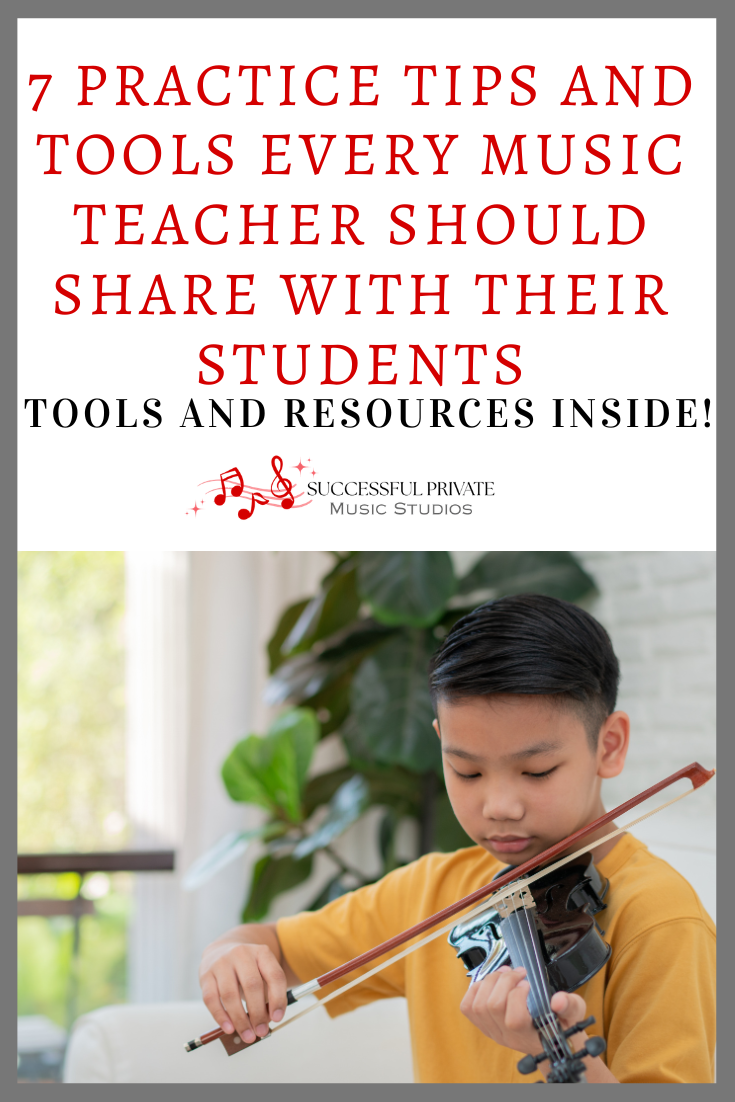
If you've been teaching for any length of time, you already know the truth: what happens in the lesson room is only half the equation.
The other half happens at home — alone, without you there, with every distraction imaginable competing for your student's attention.
Getting students to practice consistently is one of the biggest challenges in private music teaching. But the right tips and tools can make a real difference — not just in how much students practice, but in how effectively they use the time they have.
Here are seven practice strategies and tools worth sharing with your students (and their parents) right now.
1. Set a Specific Practice Time — Not a Practice Goal
Most students are told to "practice 30 minutes a day." The problem? Thirty minutes of distracted, unfocused noodling isn't practice — it's just time spent near an instrument.
A better approach: help students schedule a specific, non-negotiable practice window each day. Same time, same place, every day. Before school. Right after. Before dinner. It doesn't matter when — what matters is that it becomes as automatic as brushing teeth.
Research consistently shows that habit stacking — attaching a new habit to an existing one — is one of the most effective ways to build consistency. "After I get home from school, I practice for 20 minutes before I do anything else" is far more effective than a vague intention to practice sometime today.
Share this with parents at enrollment and revisit it any time a student starts slipping on their practice consistency.
2. Use a Timer — But Not the Way You Think
Most students use a timer to track how long they've practiced. That's fine, but there's a smarter way to use one.
Introduce your students to the Pomodoro method — 25 minutes of focused practice followed by a 5-minute break. For younger students, shorten it: 15 minutes on, 3 minutes off. The timer creates a sense of urgency that keeps students focused, and the built-in break prevents the mental fatigue that turns practice sessions into frustration fests.
Tool to recommend: Any basic phone timer works, but Focuskeeper is a free Pomodoro app that's simple enough for older students and teens to use independently.
3. Practice Hands Separately — Then Put It Together
This one sounds obvious, but it's worth repeating to students and parents regularly because it's the step most students skip when they're rushing through their practice.
Hands-together practice feels like progress. Hands-separate practice is progress.
Teach your students to isolate the hard spots, master each hand independently, then combine. And when something goes wrong hands-together, the answer is always to go back to hands separate — not to run the passage again and hope for the best.
A simple practice chart with checkboxes for "right hand," "left hand," and "hands together" can make this feel structured and achievable rather than tedious.
Just Getting Started?
Music Studio Startup Toolkit
If you're launching a new studio and want a clear framework for everything — pricing, policies, branding, and a full 30-day launch roadmap — this is your starting point. 65 pages. Instant download.
$50 · one-time · instant download
Get the Toolkit →4. Record Yourself
This is one of the most powerful and underused practice tools available — and it costs nothing.
Encourage your students to record a short video of themselves playing their current piece at least once a week. Not to perform. Not to share. Just to watch and listen back.
There's something that happens when students hear themselves from the outside. Tempo rushing, dynamic flatness, notes that aren't quite clean — things they completely miss while playing suddenly become obvious. It also builds the habit of self-assessment, which is one of the most valuable skills a musician can develop.
For younger students, this works especially well when parents watch with them and ask simple questions: "What did you like about that? What would you want to fix?"
Tool to recommend: Any smartphone camera works perfectly. For students who want to go further, Tonara is a practice app that lets teachers assign and track practice, and students can submit recordings directly through the app.
5. Use a Metronome — And Start Slower Than You Think
Every teacher says this. Every student ignores it. Keep saying it anyway.
The metronome isn't a punishment — it's the most honest feedback tool in music. It doesn't care how musical the phrase felt. It just tells the truth about whether the tempo was steady.
The key is teaching students how to use a metronome effectively, not just telling them to turn one on. The process: find the tempo where you can play the passage perfectly, every time, with zero errors. That's your starting tempo. Add 2–4 BPM only when you've nailed it three times in a row.
Tools to recommend:
Metronome Online — free, browser-based, no download needed
Pro Metronome — free app, clean interface, great for students
TempoPerfect — free desktop option for students who practice at a piano or keyboard
6. Break It Down — The 3-Times Rule
When a student hits a hard passage, the instinct is to back up and run the whole piece again from the beginning. This feels productive but accomplishes almost nothing.
Teach your students the 3-times rule: isolate the difficult measure or passage. Play it correctly three times in a row — not three times total, but three times in a row without a mistake. Then expand: add one measure before it, play that correctly three times in a row. Add one measure after. Work outward from the hard spot until it's absorbed into the whole piece.
This approach works because it forces genuine repetition of the actual problem rather than diluting it with repetition of everything the student already knows.
A simple printed practice card with this sequence makes it easy for students to follow at home without you there.
Ready to Build a Studio That Runs Like a Business?
Successful Music Studio Strategies — Signature Course
59 lessons covering everything from student retention and scheduling systems to income growth and studio policies. This is the complete roadmap for building a studio that's full, profitable, and sustainable — on your terms.
$1,250 · or 3 payments of $500
Learn More →7. Make Practice Visual With a Chart
For younger students especially, a visual practice tracker is one of the most effective motivation tools you can put in their hands.
It doesn't need to be complicated. A weekly chart with their pieces listed, a column for each day, and a simple checkbox or sticker system is enough. The act of marking off a completed practice session gives students a small but real sense of accomplishment — and parents a clear picture of what's actually happening at home.
Tools to recommend:
A simple printed practice chart you create in Canva — keep one as a template you can print and hand out at lessons
Practice First — a digital practice tracker designed specifically for music students
iReal Pro — more advanced, but great for older students working on improvisation and theory alongside their pieces
The best practice chart is the one your student will actually use. Start simple and build from there.
Practice doesn't have to be a battle — for your students or for you. The right systems, tools, and habits make consistent practice feel less like a chore and more like a natural part of the day.
And when students practice well at home, lessons become more productive, progress accelerates, and students stay enrolled longer. That's good for them — and good for your studio.
Happy Teaching!
Becky
Keep the momentum going
What do you need next?
⭐ Start Here
🗺️ Launch Your Studio This Fall
Startup Toolkit · $50 · Business plan, pricing, branding & 30-day roadmap →
📄 Get Your Studio Policies Set
Done-for-You Policy Templates · from $125 · Ready to customize →
🎓 Build a Studio That Runs Like a Business
Signature Course · 59 lessons · Everything to launch & grow →
🗺️ Not Sure Where to Start?
Free · 2 minutes · Start Here page →
Key Essentials: Everything You Need to Launch Your Own Private Music Studio

Ready to start your own music studio? First, you have to have a couple of things to be able to teach music lessons. (This post contains affiliate links)
1) Choose a method series that you will follow. for private piano lessons, I love the Faber & Faber Piano adventures and have been using the series for the past 15 years. It’s a little slower-paced than other series’ out there, but it develops a strong foundation in rhythm, and note names from the beginning BEFORE introducing more complex note values.
2) Invest in a piano. You don’t have to have a huge grand piano to start or an acoustic piano. You can start your studio with just an electric or digital piano. Here are 2 options that work well. A Full size 88-key weighted piano or here’s an option that you can take with you for easy portability as a traveling music teacher! Both are Yamaha which are considered the gold standard in electric pianos.
3. Students! For that I suggest you start here: STARTING YOUR STUDIO STRATEGIES to learn the secrets to geting your stuio started. And don’t forget, 12 Week Online Course Successful Private Music Studio Strategies to help you get started, build and create a successful and THRIVING private music studio! You can check that out here.
4. Studio Policy to set the boundaries and expectations with your new students. I’m a huge advocate for having an ironclad music studio because I’ve been there, where I didn’t have one and was taken advantage of by not getting paid, taken seriously, or families wasting my time by not showing up for lessons. Set yourself up TODAY with a strong ironclad studio policy to avoid any problems down the line. Check out my Successful Private Music Studio Policy Templates here! You can get a done for you studio policy, that is ironclad and stands the test of time. It took me years, to create this studio policy making sure I covered ALL THE BASES of expectations, to help new teachers just like you.
5. Bookkeeping. For business purposes, you need to be tracking income. This is how you can track your growth and continue to grow. Again, I’ve taken all the steps to help get you started, but providing ALL the templates I use for bookkeeping purposes with step by step videos to walk you through how to customize it for you and your business, from invoices (Lesson Summary) Receipts, student organizing, total money earned plus more! Check out my Successful Private Music Studios Bookkeeping Online Mini Course!
Happy Teaching!


I’m Becky and Welcome To Successful Music Studio Strategies where I help you create your own Successful Private Music Studio business through simple strategies I’ve learned and used in my own successful private music studio! Want to learn more about my online courses to help you start, build and create a successful and THRIVING music studio? Click here!