

Post Categories: What do you need help with?
Starting Your Studio
Keep Your Studio Running
Making Your Studio Thrive
Turn Your Fun Habit Into A Side Hustle or Business

I perform on the French Horn with our local symphonic band in our town. It’s a great way for me to continue my education in band music but also develop my talents and perform regularly. It’s an 80 piece ensemble filled with so many talented musicians. We are all adults and have other things we do during the week. But, a majority of the people in the band, don’t teach lessons, or have never taught lessons. I get it. Not every one wants to be a teacher, but when I talk to some of the musicians and they are either retired, in between jobs, or struggling to like their current job, or just looking for something more to do with their life (hello stay at home moms!), the first t thing I asked them was, “have you thought about teaching?” Most of them think I’m crazy, but honestly, we need more teachers out there.
Have you ever thought about teaching? It’s a great way to add a little supplemental income or if you are wanting to go in full time, you can make it work. The key though…START! Here’s some secrets to get you started!
1) Decide what levels you feel comfortable teaching through. Most anyone with an intermediate based or higher piano skill can teach beginning piano.
2) Decide what books you plan to use. I personally have been using the Faber & Faber Piano Adventures. But my son, who is with another piano teacher uses the Piano Town books.
3) Decide how many days you want to teach and the time available that you can and that will determine how many students you can teach. If you can teach 2 days a week for 2 hours each day, that’s 4 students with 30 minute lessons! (If your lessons are between $80-$100 / month then that’s an extra $320-$400, teaching just 4 hours a week.)
4) You don’t have to teach from your house, you can be a traveling teacher (plan time between lessons to drive to the next location.) Or rent a space at a local music store or check with other venues that might be available like in a church or other spaces.
5) Place up some advertisement at local stores or talk to friends to spread the word. Then get teaching.
🌟 Create a professional atmosphere from the start with one of our ironclad Music Studio Policies where we go over tuition costs, and how to answer all the questions a parent will have before they start working with you and make sure you have all the backend bookkeeping tools and templates to help you stay organized in your new business with our Bookkeeping Powerhouse Kit.
In the end, you won’t know unless you try! And if you feel like, “man, I just need more help getting this started”…my Successful Private Music Studios Strategies 12 Week Online Course is going to be your answer! Coming soon!! So make sure you get on our mailing list because everything you need to build, grow, run, and create a successful and THRIVING private music studio is INCLUDED in the course!
Happy Teaching,
xo Becky
Holiday Recitals And How To Squeeze Them In During The Busiest Time of The Year

The holidays are quickly approaching, and you want to showcase your student’s hard work! GREAT! But, how do you make time in your and all your student’s families for a recital?
GET A LOCATION NOW! Start calling around at churches , or facilities asking what is available before you set a date. Or if you already know a date ask specifically for that date.
Be flexible on TIME OF DAY. Sometimes most families have an easier time with midday recitals when they have other activities during the evening.
Use the opportunity to do community service. With Covid, this might not be possible, but for the future, other locations that you can perform are: Retirement or Senior Centers, Malls, Even at the Hospital. You have to get prior permission and there might be other rules attached, but I consider this a Community Service project as a way to give back to the community.
Pick an odd day. Wednesdays and Thursdays seem to be an odd day for many activities and often don’t have a conflict. So try these days instead of a typical Friday or Saturday.
Try to notify your parents AS SOON AS YOU HAVE YOUR RECITAL DATE. And know, that someone might not be able to participate, and that’s okay, it happens. Life is busy at the holidays. goal is to be as early as possible with notifying so they have enough time to put you on their calendar before it fills up over the next month.
Last tip: AIM TO KEEP YOUR RECITAL SHORT! 1-2 songs most, and let the parent’s know you would like to keep it short. Don’t go overboard with the recital. Just some holiday favorites, to show off the progress of your students.
Happy Teaching!
Becky
Private Music Lessons Practicing Incentives
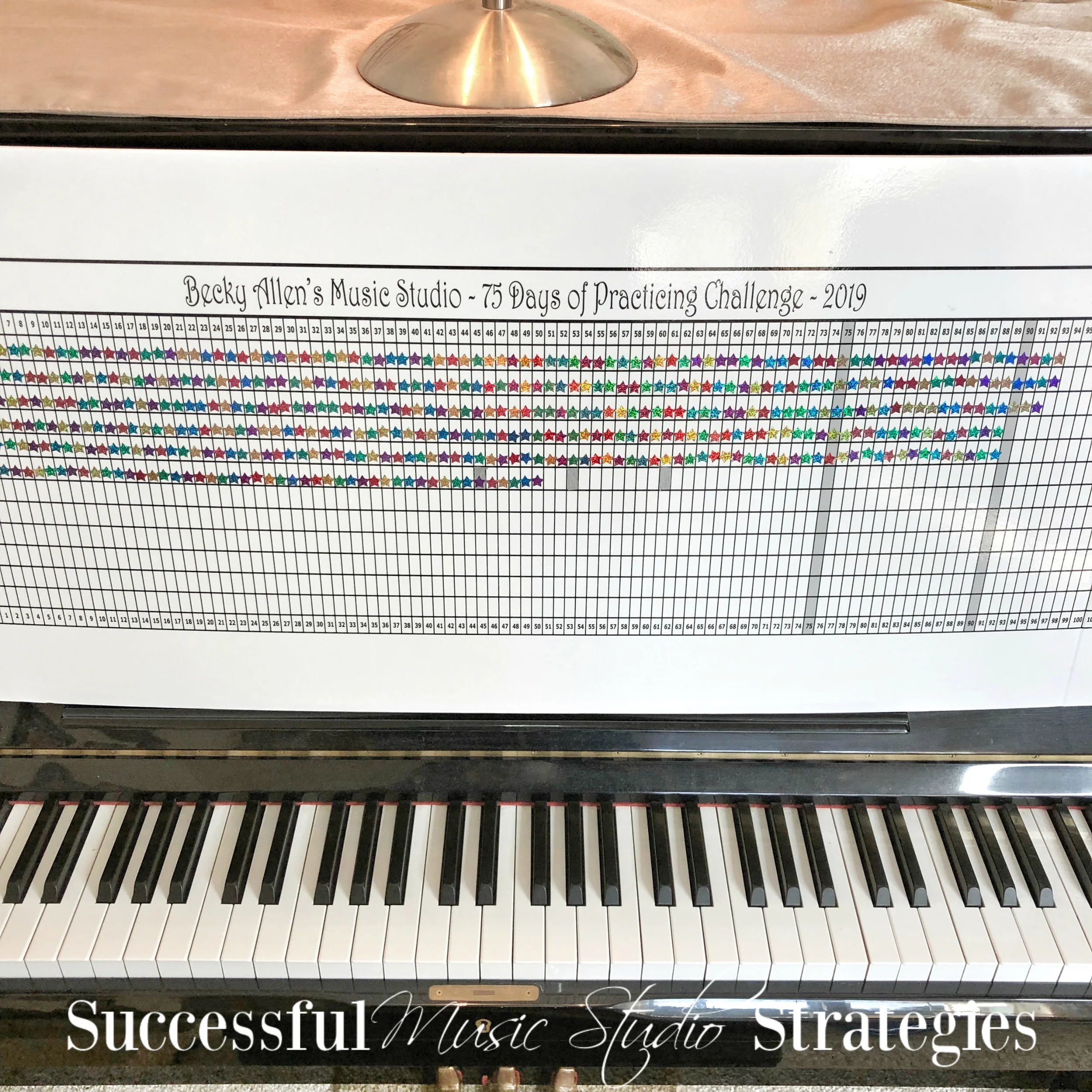
Do you struggle getting your students to practice? The best way to help your students want to practice is through incentivizing. Give them a challenge and see what they do with it. Kids love to be challenged and when you make the reward SWEET they are more than likely going to do whatever they can to practice.
In my studio we have the 75 Days of Practicing Challenge in the spring. It really is a way ensure that they practice their recital songs. But really, everyone should reach the 75 days of practicing. The challenge is when they practice for more that 75 days.
75 Days Of Practicing Rules:
15 week challenge (kids are already required to practice 5 days a week anyways)
At least 10 min practicing a day for it to count for a sticker
Reward for practicing 75 days (5 days a week for 15 weeks): Studio T-shirt (your student becomes a walking advertiser for your studio!)
Reward for practicing 90 days (6 days a week for 15 weeks): Studio T-shirt, candy bar of choice
Reward for practicing 103 days ( 7 days a week for 15 weeks): Studio T-shirt, candy bar of choice, bag of candy
Entire studio reaches 100 Days of practicing: Pizza party at Spring Recital
Entire Studio reaches 103 Days of Practicing: Pizza party and Ice Cream Party at Spring Recital!
There are plenty of other challenges or practicing programs you can do for your students but for us this has been the way to go! Comment below what practicing challenges that you have thought about or done in your studio!
Happy Teaching!
xo, Becky
New School Year Means New Students Ready To Start Private Lessons | BEST Tips For Budget Friendly Advertising

I LOVE the new school year! It’s that time of year where parents want the best, and enroll their kids in ALL the after school activities. Especially music lessons!
If you are thinking about starting your own studio RIGHT NOW IS THE TIME TO ADVERTISE that you are open / will be open for business this school year.
Then get to the presses and start making posters you can display or hand out to interested potential families.
BEST TIPS FOR BUDGET FRIENDLY ADVERTISING:
UTILIZE FREE ADVERTISING BULLETIN BOARDS! There are lots of places you can find a bulletin board. Make sure though that it’s open to anyone to post on first because some bulletins only allow non profit or have requirements to be able to post. Speak with the store manager first. Panera Bread has a bulletin board along with many grocery stores!
UTILIZE LOCAL BUSINESSES! You can also ask local shops or stores if you can display business cards or a poster in their shop. This becomes All FREE to advertise!
FACEBOOK and INSTAGRAM ARE YOUR PERSONAL STORE FRONTS! You can make a post on your personal feed or business page and ask your local friends to share your post. And to make sure you stand out in local searches make sure to tag your city so that will show up on the search bar and in local friends posts.
BE THE ONE ALL THE MOMS WANT! Have you joined the local Facebook mom group? MOPS or often times there is just a local mommy group. Moms are ALWAYS asking for recommendations for a music teachers. Be the one that posts and also if you post in there enough, they will start to tag you as, “so and so is a teacher!'' My babysitter is super active on those pages and whenever she sees someone asking she always recommends me so that’s super helpful too! WORD OF MOUTH!
NEIGHBORHOOD ADVERTISING! Gone are the days of putting advertisements in the mailbox, you can still do that but another great idea to advertise, subdivision newsletters or the Facebook Neighborhood Page. Scope out your area and nearby neighborhoods and contact the HOA to see if you can be included in the next neighborhood newsletter or on their group page. There might be a fee, but with a newsletter that has 600 residences or more it might be a worthy investment. Most HOA’s newsletters, are reasonable.
WHAT TO USE FOR ADVERTISING POSTERS: You don’t have to spend major bucks to get your name out there, you just have to be consistent with posting flyers, telling people that you teach lessons while you are at church, or with the groups you are part of or even when you are out and about at the grocery store. Flyers that you post don’t have to be fancy either about your advertisement. Don’t go spend money on a thick poster board or pamphlet at Staples. While they look nice, they cost a pretty penny to make, it’s not really that necessary. Check out my typical poster I’ve used and had great success with when I have to advertise. I love using the little tear away strips, that you pre cut, because you get more use out of your flyer and you can continue to check in on it and see how much interest there is. Check back in a week and if only 1 tab is missing might be time to relocate it. If all the tabs are missing, PUT UP A NEW FLYER!
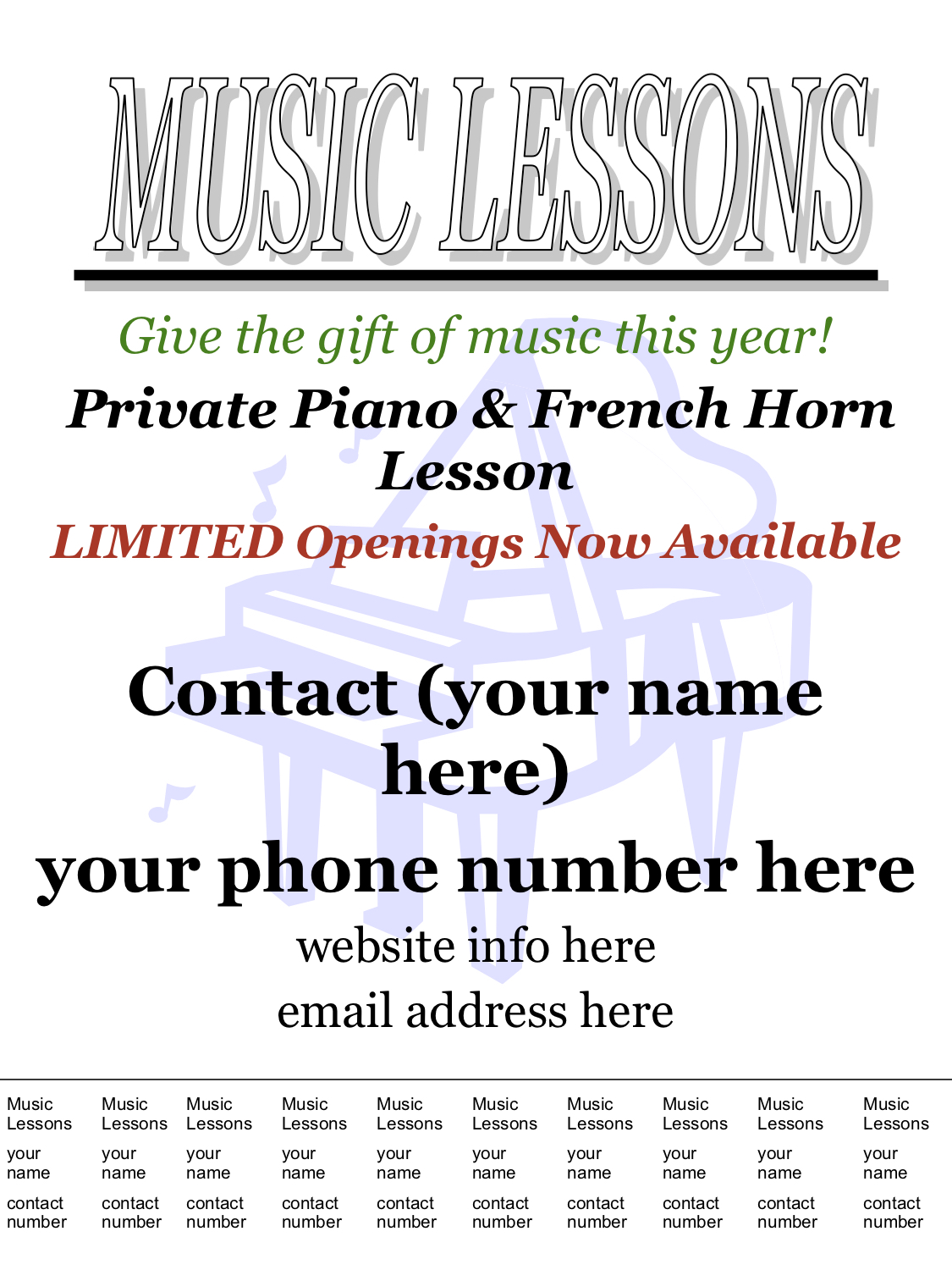
The best advice is to make your advertising, keeping it simple for you to make over and over again, efficient and to the point and easy for your prospect families to use so that you get your email box filled with prospect students wanting more info and the phones ringing!
Next step is to be prepared for what they are going to be asking you when they call to check your availability.
STARTING YOUR STUDIO SOON? You need to have a studio policy! Once a parent says, “YES! We’d love to start with you!” You need to have a policy in place as a way to protect you and your business and help answer all the questions before they happen. GET YOUR CUSTOMIZABLE PRE-MADE TEMPLATE HERE that covers Tuition Fees, What happens during snow days, Termination Policy, Studio schedule and more!
Be on the lookout! Get more in depth info and strategies like these in my upcoming COMPLETE 12 week course releasing this fall to help you START your studio, BUILD your students, RUN all the internal stuff easily, and MAINTAIN a THRIVING and SUCCESSFUL Private music studio! Be the first to know more by SUBSCRIBING TO OUR LAUNCH EMAIL LIST! Hours and hours have been put into the course and I know it will help make your life easier in setting up your studio and helping it run more efficiently!
Happy Teaching,
xo Becky
How To Become A Private Music Teacher And Start Teaching Lessons At Home In Your Own Business

Whether you've been playing your instrument for years and people keep telling you "you should teach," or you're actively looking for a flexible way to earn income doing something you love — private music lessons might be exactly what you've been looking for.
Teaching privately is one of the few businesses where you are the product. You set the schedule. You choose your students. You decide what you charge. And with the right foundation in place, even a part-time studio of 15–20 students can generate a real, reliable income — on your terms.
But here's what nobody tells you upfront: the teaching part is actually the easy part. The part that trips most new teachers up is the business side — pricing, policies, communication, scheduling, and setting up systems that don't burn you out by month three.
This post walks you through both. By the end, you'll know exactly what it takes to become a private music teacher and how to set your studio up the right way from day one.
Do You Have What It Takes to Teach?
Let's start with the question most people are secretly asking: Am I qualified to do this?
You don't need a music degree. What you need is a competent, working knowledge of your instrument and the ability to communicate what you know clearly to someone else. Those are two different skills — and both matter.
Musically, you should be able to:
Read music fluently, including notes, rhythms, dynamics, and basic music theory
Demonstrate proper technique on your instrument
Identify what a student is doing wrong and explain how to fix it
Teach to your own level of playing — no further
That last point is important. If you studied through early-advanced repertoire, that's your current teaching ceiling. As your own playing develops, your teaching range expands with it. There's no shame in that — it's honest, and your students will be better served for it.
By instrument, you'll also need:
Piano: Hand independence, scales, chord structure, and repertoire appropriate to each level
Strings: Bow technique, left-hand position, posture, tuning, and instrument maintenance
Winds: Embouchure, breath support, tone production, fingerings, and instrument care
Voice: Breath support, vowel placement, healthy technique, and range development
Beyond the music, great teachers also bring:
Patience — real patience, not just the "I'll try to be patient" kind
Consistency and reliability — students and families need to be able to count on you
The ability to adapt — a 7-year-old beginner and a 45-year-old adult learner need completely different approaches
A genuine interest in each student's progress, not just the lesson itself
If you're reading this and nodding along — you can do this. Beginning students don't need a virtuoso. They need a prepared, professional, engaged teacher who shows up the same way every week.
How to Actually Get Started
Once you know you're ready to teach, the next step is building the structure around it. This is where most new teachers either set themselves up for long-term success — or create a mess they spend years trying to untangle.
Step 1: Decide how many students you can take.
Be realistic here. Map out your available teaching hours in a week, then work backward. Factor in prep time, lesson time, and buffer between students if you're teaching in your home. A typical breakdown looks like this:
Beginners: 30-minute lessons
Intermediate: 45–60 minutes
Advanced: 60 minutes or more
Most new teachers start with 8–12 students and build from there. That's a manageable load while you're finding your rhythm — and it still adds up to real income.
Step 2: Set your rates with confidence.
This is where new teachers consistently undercharge — and it's a mistake that's surprisingly hard to undo. Parents anchor to your original price. If you start too low and try to raise rates later, it creates friction and sometimes costs you students.
Do your research: find out what other private teachers in your area charge. Then price yourself at or near the market rate based on your experience and credentials. Don't price yourself at the bottom just to attract students. Undercharging attracts the wrong students and devalues your work from the start.
Step 3: Choose your teaching space.
You have more options than you might think:
Teaching from home: You'll need a clean, quiet, dedicated space with easy restroom access. This is the most common setup for independent teachers and the most flexible.
Music stores: Many rent space to independent teachers. They'll often ask for credentials, so be prepared to share your background.
Churches, community centers, or schools: Surprisingly accessible — many will let you use a room for a small fee or in exchange for some community involvement.
Online lessons: Zoom and FaceTime have made location irrelevant for many teachers. Online is a legitimate, professional option — especially if you're just starting out or want to expand beyond your local area.
Step 4: Get your business basics in order.
Even a small private studio is a business, and the IRS will treat it like one. From day one, you need to:
Track all income received — every payment, every student, every month
Decide how you'll collect tuition (Venmo, check, auto-pay, invoicing)
Open a separate bank account for studio income if you can
Keep receipts for any studio-related expenses — they're deductible
This doesn't have to be complicated. A simple spreadsheet works when you're starting out. What matters is that you build the habit of tracking from the beginning, not six months in when you're scrambling before tax season.
The One Thing Most New Teachers Skip — And Almost Always Regret
Studio policies.
Before you take your first student, you need a written studio policy. Not a casual verbal agreement. Not a "we'll figure it out as we go." A real, clear, written document that every family receives and acknowledges before lessons begin.
Your studio policy is the foundation of every professional relationship you'll have as a teacher. It sets expectations, prevents misunderstandings, and protects your time and income before problems even arise.
A complete studio policy covers:
Tuition: How much, when it's due, how it's paid, and what happens if it's late
Cancellations and makeups: Your rules, not theirs — and yes, you get to have rules
Scheduling: Your available hours, how changes are handled, and your commitment to consistency
Communication: How and when families should contact you, and your expected response time
Enrollment: How new students join, what a trial lesson looks like, and how either party ends the relationship
I can't tell you how many teachers have come to me after a year or two of teaching saying the same thing: "I wish I had done this from the start." A student who stops showing up without notice. A parent who expects free makeup lessons every time their kid has a baseball game. A family who ghosts you in December and then disputes a charge in January.
Policies don't prevent every problem — but they give you something to point to when problems come up. And they do come up.
What a Thriving Studio Actually Looks Like
Here's the truth: almost anyone with musical ability and good intentions can get their first handful of students. What separates teachers who burn out after two years from teachers who are still doing this happily a decade later comes down to systems.
Systems for how you enroll students. Systems for how you communicate with families. Systems for how you track your money, plan your recitals, handle difficult conversations, and grow your income beyond just adding more lesson hours.
Because here's what happens without systems: you hit a ceiling. You're fully booked at 20 students, you're exhausted, your rates haven't kept up with your experience, and you have no idea how to grow without working more hours you don't have.
The teachers who build truly sustainable studios — ones that give them real income, real flexibility, and real joy — are the ones who treat their studio like a business from the beginning. Not in a cold, corporate way. In a "I respect my own time and I've built something I'm proud of" way.
That's what I've spent nearly 30 years learning, and it's exactly what the Signature Course is built to teach.
You Don't Have to Figure This Out Alone
Starting a private music studio is one of the most rewarding things you can do as a musician. It's work — real work — but it's work that fits around your life, plays to your strengths, and can grow into something you're genuinely proud of.
The teachers who succeed aren't always the most talented musicians in the room. They're the ones who show up consistently, set clear expectations, and build real systems around the gift they already have.
You've got the musical ability. Now build the business around it.
Happy Teaching!
Becky


I’m Becky and Welcome To Successful Music Studio Strategies where I help you create your own Successful Private Music Studio business through simple strategies I’ve learned and used in my own successful private music studio! Want to learn more about my online courses to help you start, build and create a successful and THRIVING music studio? Click here!