

Post Categories: What do you need help with?
Starting Your Studio
Keep Your Studio Running
Making Your Studio Thrive
Key Essentials: Everything You Need to Launch Your Own Private Music Studio

Ready to start your own music studio? First, you have to have a couple of things to be able to teach music lessons. (This post contains affiliate links)
1) Choose a method series that you will follow. for private piano lessons, I love the Faber & Faber Piano adventures and have been using the series for the past 15 years. It’s a little slower-paced than other series’ out there, but it develops a strong foundation in rhythm, and note names from the beginning BEFORE introducing more complex note values.
2) Invest in a piano. You don’t have to have a huge grand piano to start or an acoustic piano. You can start your studio with just an electric or digital piano. Here are 2 options that work well. A Full size 88-key weighted piano or here’s an option that you can take with you for easy portability as a traveling music teacher! Both are Yamaha which are considered the gold standard in electric pianos.
3. Students! For that I suggest you start here: STARTING YOUR STUDIO STRATEGIES to learn the secrets to geting your stuio started. And don’t forget, 12 Week Online Course Successful Private Music Studio Strategies to help you get started, build and create a successful and THRIVING private music studio! You can check that out here.
4. Studio Policy to set the boundaries and expectations with your new students. I’m a huge advocate for having an ironclad music studio because I’ve been there, where I didn’t have one and was taken advantage of by not getting paid, taken seriously, or families wasting my time by not showing up for lessons. Set yourself up TODAY with a strong ironclad studio policy to avoid any problems down the line. Check out my Successful Private Music Studio Policy Templates here! You can get a done for you studio policy, that is ironclad and stands the test of time. It took me years, to create this studio policy making sure I covered ALL THE BASES of expectations, to help new teachers just like you.
5. Bookkeeping. For business purposes, you need to be tracking income. This is how you can track your growth and continue to grow. Again, I’ve taken all the steps to help get you started, but providing ALL the templates I use for bookkeeping purposes with step by step videos to walk you through how to customize it for you and your business, from invoices (Lesson Summary) Receipts, student organizing, total money earned plus more! Check out my Successful Private Music Studios Bookkeeping Online Mini Course!
Happy Teaching!
10 Proven Strategies to Keep Your Music Teaching Business Running Successfully

As a music teacher and entrepreneur, you know that running a successful teaching business can be challenging, but also incredibly rewarding. Whether you are just starting or have been in the industry for years, there are always new strategies and techniques to learn and implement to grow your business and keep it running successfully. In this article, we will explore 10 proven strategies that will help you keep your music teaching business running smoothly and successfully. From creating a solid business plan to leveraging social media and building strong relationships with your students and their families, you will discover practical tips and insights that will help you take your teaching business to the next level. So, whether you are looking to attract more students, increase your revenue, or simply improve the quality of your teaching, read on to discover how you can achieve your goals and build a thriving music-teaching business.
Develop those long-term friendships with your student. Make lessons fun, and have a candy bowl. When your student is super excited to come to lessons or practice at home, the parents will see that and will love that they don’t have to work as hard to get their kid into lessons. They will thank you for it and will tell their friends all about you and your business and referrals are GOLD as a small business.
Offer a referral incentive. This goes right along with #1. The more your students bring, the more in demand you become. Make sure you have a stipulation, that only 1 benefit is awarded monthly. For my studio, the students will receive 1 free month of lessons once a referral student starts. You can stipulate, max 2 referrals a semester, or good for any month of their choosing. But this is something to have added to your Studio Policy!
Create a Lesson Agreement that new students have to continue lessons for 4-6 months (you decide the length) to allow enough time for the student to fully get the basics learned and if music is right for them. This shows the parent you are worth investing in for at least a determined amount of time.
Create a solid business plan of a set teaching schedule and even make up lesson frequency, and stick with it. When you treat your business like a business, you will be regarded as a business, not just the neighborhood piano teacher that is doing this in their spare time.
Word of Mouth! Referrals are GOLD, but you still have to tell people that you are a teacher/offer music lessons. ADVERTISING is necessary for any business. People won’t know unless you tell them about it. Get business cards made and carry some with you everywhere you go. Hang one up on community boards when you see one. Leave it on a counter at a business where other cards are being left.
Think outside of the box in what you can offer. Offer to record music and splice recordings together, be an accompanist, offer songwriting workshops, theory workshops…The list can go on and on! You can check out more ideas in this post about innovative teaching opportunities!
Don’t feel like you have to cater to the masses. Limit your studio to what you can realistically handle. And price your tuition at what you are truly worth, not what others think you are worth. Teaching can take a lot out of you, especially if you are teaching in small pockets during the week or weekend after working another job during the day.
Build a waitlist. While it’s hard to say, “I have no room right now” when you "might “ be able to add an extra lesson day in to accommodate every student that comes calling, you will be making sacrifices somewhere else. For me, I teach 3 days a week almost right as soon as school gets out and often finish teaching when it’s my kid’s bedtime. I dedicate 2 days that I don’t teach so I can help my own kids with after-school studies and have time with them. If I gave that time up for more lessons, I miss more time with my kids.
Value your time. Don’t be the teacher that always goes over lessons and makes another student wait. Just like going to a doctor’s office, no one likes having to wait beyond their specified time. If a student is late, there is no make-up time at the end of lessons. When you respect your time, the families will too. And things happen, but when it becomes a constant problem, address it with the parent as “Is there another time in the week that works better for your family.”
Incentives work wonders for kids and families. When you have a challenge for your kids to work towards with BIG REWARDS. Believe it or not, candy does the trick, especially when they get to pick what candy they are getting. Be very clear about how the student earns the reward. I usually send an email out to families with the challenge rules. And check in weekly with either a practice chart/sticker chart or have some way to track progress over time so they can see their progress.
When you use these proven strategies, your studio will not only be in demand but will prosper the test of time with loyal families that come back year after year and you will be able to continue to grow your business on your terms and make it a fun place for your students!
Happy Teaching!
Strike the Chords of Your Success: A Comprehensive Guide to Hosting a Flawless Online Music Studio Recital

The world is in a different place right now, but the show must still go on. Whether you had to move your private music lesson business online or you’ve decided to stay or choose to teach online, we still want to showcase our students the best way possible and that happens with a RECITAL!
1) Use the same platform you teach lessons on for your recital. I personally use Zoom. It’s easy to use and currently, there is no max time limit on how long you can host a group event. (I suspect things will change in the future) But be mindful of the max time limit for online group events.
2) Send out specific and detailed instructions to the families 2 weeks prior to the recital about how and where to set up the camera — for my piano students, I request a profile view so we can see the student’s hands and some of their faces. —so that the student can be seen and heard. Also, advise them about extra lighting. Set up a lamp next to them (in front of them) or a ring light so that their child is well-lit and everyone can see them easily.
3) Send an email to all families with the link and a special password to access the online event 2 weeks before the recital so they can send it to their family members who want to attend.
4) Set up the link that people can’t just automatically enter, that they will be entered when the host allows, so you can get the exact time you need for the recital. Also, so they are automatically muted when they enter so you don’t have to go through and mute everyone or when new people join halfway through the recital because they missed the initial time, they will be automatically muted.
5) The morning of the recital email the recital program to all the families and ask them to email it to those that are joining in so that they have a program to follow. This works as a great reminder the day of the recital to ensure everyone remembers!
6) Be short and quick. Most people are taking time out of their day to attend to listen to the performances but keep your remarks and intros for the students short. You don’t have to give details about every student before they perform or at the end of the performance. The families are there to listen to the student perform. Plus if there is a time limit you want to make sure everyone has access to listen to all the performances.
Happy Teaching!
10 Proven Tips for Launching a Successful New Music Teaching Business

Are you passionate about music and eager to share your knowledge with others? Becoming a private music teacher can be a fulfilling and lucrative career path. However, it's not just about having musical skills; communication and recruitment are also crucial aspects of the job.
Get your name out there. Set up a free website to have a landing page for people interested able to start somewhere, because most searches start online. Start hanging flyers up, and advertise at local coffee shops, neighborhood newsletters, and community boards online. Become the name people know and recognize.
Start thinking about how you can effectively communicate with parents. Start practicing answering common questions that are asked. You can see some of the top ones I’ve encountered here. The goal is to get them on the phone and chat with them, or in your door for a trial lesson to make sure things click between you and the family. 🎶 The trial lesson does not have to be free. That’s your choice, but remember, your time is worth something. You can always start offering free trial lessons, and change at a later time too.
Select the method books you are going to be teaching from. There are a lot of choices out there and take the time to sit down with the different method books and decide what you feel most comfortable with. For private piano lessons, I use the Faber & Faber Piano Adventures.
Create your business model and scheduling. To maximize your time spent teaching block off time in your week and schedule all lessons back to back. Have the students come to you if you can and just keep them rolling in one after another. You can teach a lot of students in very little time.
Bookkeeping is essential to track your business. From income tracking, to tuition statements, you will want to have some form of Bookkeeping. I created a mini course with all the Bookkeeping tools I use so you can become a powerhouse too, plus accompanying videos on how to customize all documents on your computer for your studio! Check it out here! Successful Private Music Studios Bookkeeping Powerhouse Mini Course.
Start working on your musicianship skills. You’re going to be teaching others, but still take the time to keep developing yours. From working on a new piece of music to joining a local community ensemble to perform with. 🎶 This creates Credentials that you are actively performing still is a great talking point for why learning music can benefit not just as a child but later in life too. Even if you are just back into picking music back up.
Create a studio policy so that all the questions regarding your music studio is answered before the student comes to the first lesson. That way you establish the rules, sets you up as someone who’s taking this seriously and leaves out any questions for what to do when. You can get my IRONCLAD ready made studio policy template that you can customize to fit your studio. I walk you through exactly how to customize it to truly make it your own. You can get it here: Successful Music Studio Policy Templates Mini Course.
Set a goal for how many students you want to have by a specific date. Then work to start a wait list so that you will always have students in demand ready to walk through your doors.
Think outside of the box when it comes to what you can offer as a teacher. Can you teach more than one instrument, a primary and a secondary? Are you an accompanist? Can you sing? List what you can offer on your website.
Create a fun atmosphere for your students from the moment they walk in the door. Believe it or not, even just having a simple candy bowl from them to take a piece of candy from at the end of lessons, will make them want to come back week after week, year after year. You can also create sticker charts, or challenges for them to work for prizes from a “treasure box”. Practice x amount of days and they get to take a prize from the box. Keeps them engaged and excited.
Becoming a private music teacher can be an exciting and rewarding career path for those who have a passion for music and teaching. Remember that communication, recruitment, forming bonds with your students, and organization are all crucial aspects of the job. With dedication and hard work, you can help aspiring musicians appreciate their artistry and create beautiful sounds through music lessons.
Happy Teaching!
From Branding to Social Media: Tips to Take Your Music Teaching Business to the Next Level
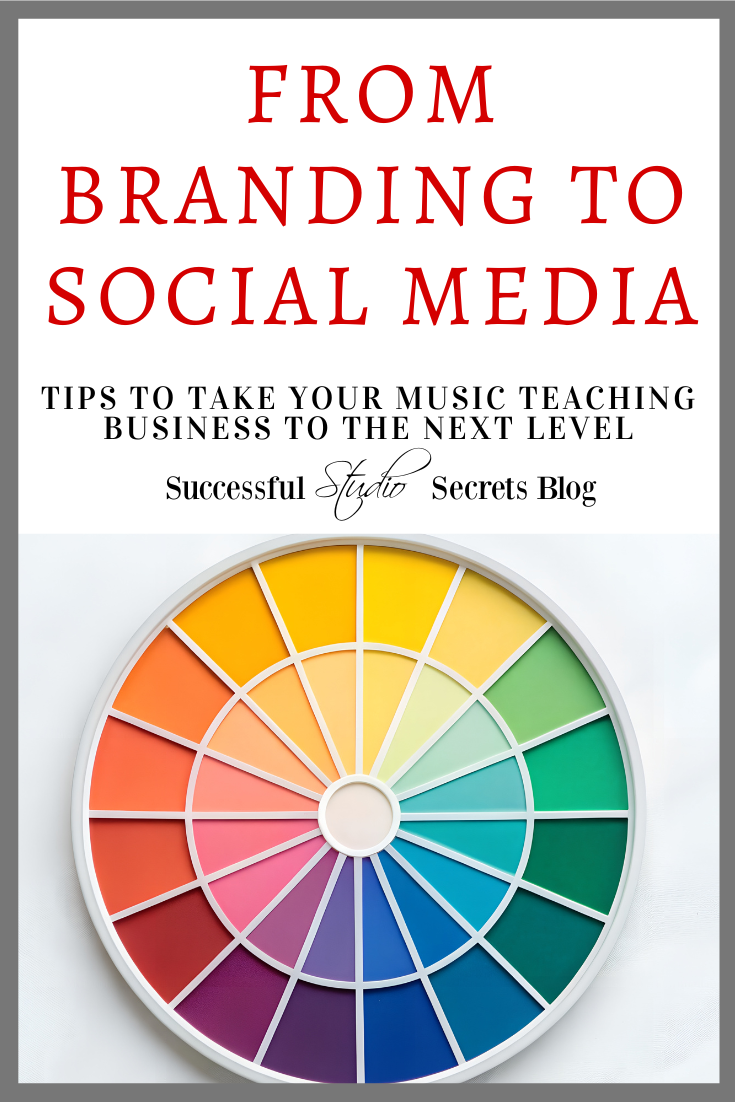
If you’re ready to grow your private music studio this year, there’s one truth you can’t ignore: great teaching is essential, but it’s not the only thing that builds a thriving business.
Your brand identity, your online presence, and the way you show up on social media all work together to shape how families see your studio — long before they ever reach out.
The good news? You don’t need to be a marketing expert to create a studio that feels polished, professional, and uniquely you. With a few intentional steps, you can elevate your studio’s visibility and attract the right students with confidence.
Let’s walk through the essentials.
1. Start With a Clear Brand Identity
Your brand identity is the foundation of your studio’s presence — online and offline. It’s the personality of your business and the promise you make to families.
A strong brand identity includes:
A clear studio name
A consistent color palette and font style
A recognizable logo
A defined teaching philosophy
A tone of voice that reflects your values
A cohesive experience across your website, emails, and social media
When these elements work together, your studio becomes instantly recognizable. Families feel a sense of trust and clarity — and that’s what leads to inquiries and enrollments.
Pro tip: If your studio feels “all over the place,” start by defining three words that describe the experience you want families to have. Warm? Structured? Creative? High‑achieving? Those words become your compass for every branding decision.
2. Make Your Online Presence Consistent and Inviting
Once your brand identity is clear, your next step is making sure it shows up everywhere families interact with you.
That includes:
Your website
Your social media profiles
Your email signature
Your studio policies and welcome packet
Your lesson materials and handouts
Consistency builds trust. When a parent sees the same colors, tone, and message across platforms, they instantly feel like your studio is organized, reliable, and professional.
Ask yourself: Does my online presence reflect the studio experience I want to deliver?
If not, this is the perfect time to refresh and realign.
3. Use Social Media With Intention (Not Exhaustion)
Social media doesn’t have to be overwhelming — especially when you use it strategically.
Here are simple ways to make it work for your studio:
Share content that reflects your brand
If your brand is warm and encouraging, share behind‑the‑scenes moments, student wins, and motivational posts. If your brand is structured and achievement‑focused, highlight practice strategies, progress milestones, and performance prep.
Post consistently — even once a week makes a difference
You don’t need daily content. You just need predictable, steady visibility.
Use captions that speak to parents’ needs
Parents want to know:
What their child will experience
How you support learning
Why your studio is a great fit
Your captions can answer those questions naturally.
Repurpose content to save time
One blog post can become:
3–5 Instagram posts
A Facebook update
A short video
A newsletter segment
You’re not creating more — you’re using what you already have.
4. Build a Studio Presence That Feels Like You
The most successful studios aren’t the ones with the fanciest graphics or the biggest social media following. They’re the ones with a clear identity and a consistent message.
When your branding and social media work together, you create a studio that feels cohesive, trustworthy, and memorable. And that’s what helps families choose you over the dozens of other options in your area.
A Quiet Hint… Something Big Is Coming
If you’re reading this and thinking, “I want to do all of this, but I need a roadmap,” you’re going to love what’s coming next.
The Music Studio Startup Toolkit is about to launch — and it includes an entire section on brand identity, plus templates, scripts, and social media tools to help you build a studio presence that feels polished and professional from day one.
If you want to take your studio to the next level this year, keep your eyes open. The next launch is right around the corner.
Happy Teaching!
Becky


I’m Becky and Welcome To Successful Music Studio Strategies where I help you create your own Successful Private Music Studio business through simple strategies I’ve learned and used in my own successful private music studio! Want to learn more about my online courses to help you start, build and create a successful and THRIVING music studio? Click here!
Bookkeeping Powerhouse Mini course and Studio Policy Templates NOW AVAILABLE!
