

Post Categories: What do you need help with?
Starting Your Studio
Keep Your Studio Running
Making Your Studio Thrive
How To Easily Transition To Teaching Online Music Lessons | TOP 5 TIPS

Online music lessons aren't a pandemic workaround anymore — they're a legitimate, long-term teaching option that opens your studio to students beyond your immediate area, gives your schedule more flexibility, and keeps your income protected when in-person teaching isn't possible.
Whether you're transitioning fully online, offering a hybrid schedule, or just want to be prepared if a student needs to go virtual for a few weeks, these five tips will help you teach online music lessons confidently and effectively.
1. Set Up Zoom the Right Way
Zoom is still the gold standard for online music lessons — it's free, reliable, and works on any device. But most teachers don't set it up in a way that protects their time and keeps lessons running smoothly.
Here's exactly how to do it:
Go to Meetings → Schedule a New Meeting and set each student up with a recurring meeting at their regular lesson time. A recurring meeting generates a custom link for each student that never changes — no hunting for new codes every week.
Scroll down to Advanced Options and turn on Waiting Room. This is essential. It lets you finish one student before the next one joins, so lessons don't overlap and students can't accidentally drop into the middle of someone else's session.
Once it's set up, send each family their custom meeting link with instructions to join 5 minutes early and wait in the waiting room. You admit them when you're ready.
2. Set Clear Online Lesson Expectations With Families
Online lessons require a different level of parent involvement — especially for younger students. Before the first virtual lesson, send a notice to all families that covers:
Where to be: Student should be at their instrument, in a quiet space, 5 minutes before lesson time
What to have ready: Their method books, a pencil, and any assigned music printed or on a stand
Late policy: If the student is late, the lesson runs for the remaining time only. You will not extend or make up the time
No-shows: Parents are responsible for remembering lesson time. You are not responsible for sending reminder texts before every session
Getting this in writing before the first online lesson prevents the most common issues — students joining from a couch without their music, parents texting mid-lesson asking if lessons are happening, and expectations around makeup lessons.
If you don't have an online lesson addendum in your studio policy, this is the time to add one.

Done-for-You Templates
Successful Music Studio Policy Templates
Your studio policy should include an online lesson section — covering platform, tech requirements, late and no-show policies, and parent expectations for virtual sessions. These fully customizable templates already have it covered. Includes a step-by-step tutorial video and lifetime access.
Advanced adds income growth strategies, student retention, and referral incentive sections.
3. Have a Copy of Every Book Your Students Are Using
This is non-negotiable for online teaching. You cannot effectively direct a student to a specific measure, fingering, or passage if you don't have the same edition in front of you.
Before you go virtual, make sure you have a physical or digital copy of every method book, piece, and supplement your students are currently working through. Keep a notebook for each student with what you assigned and any notes from the lesson — because it's much easier to lose track of where you are without the natural rhythm of handing books back and forth.
For theory work: if you don't have their theory book on hand, skip it for the virtual lesson and focus on repertoire. Don't try to improvise theory without the exact page in front of you — it wastes time and creates confusion.
4. Listen First, Then Correct
This is the adjustment that makes the biggest difference in online lesson quality — and it's the opposite of how most teachers naturally work in person.
Online audio has a slight delay. If you interrupt or correct while a student is playing, your comment arrives half a measure after they've already passed the spot you're referring to. They get confused, you repeat yourself, and the lesson loses momentum.
The better approach: let the student complete the phrase or passage. Then give your notes. Then have them go back and correct. It feels slower at first but it's actually far more efficient because your feedback lands clearly every time.
A few other techniques that help:
Use measure numbers constantly. For older students, have them write measure numbers throughout their music before the lesson. For younger students, practice counting measures together before you start.
Hold your music up to the camera when you need to show them exactly where you are. This is faster than describing it.
Mark your copy whenever you tell them to mark theirs. That way at the next lesson you know exactly what you told them to do and can check it.
Keep Your Studio Running Smoothly
Part 2 — Keeping Your Studio Running
Online lessons, scheduling systems, student retention, bookkeeping templates, and the organizational strategies that keep your studio running smoothly week after week — whether you're teaching in person, online, or both.
$500 · lifetime access
Get Part 2 →5. Give Yourself and Your Students Grace
Online teaching is a different skill set. The pacing is slower. The feedback loop is different. Some things that work beautifully in person take longer to communicate virtually.
If you or your student hit a wall of frustration mid-lesson, move on. Tell them you'll come back to it next week. That's not failure — that's good teaching. Sometimes a concept needs a week of home practice before it clicks, and pushing through frustration online rarely works.
Be open and honest with families too. Check in monthly to make sure the virtual setup is working for them. Ask if the audio quality is good on their end, if they have a good camera angle of the student's hands, and if there's anything you can adjust to make lessons more productive.
The teachers who thrive with online lessons long-term are the ones who treat it as its own format with its own best practices — not a lesser version of in-person teaching.
One more thing that helps enormously: a structured practice challenge running in the background. When students have a consistent incentive to practice between lessons, online or in person, progress doesn't stall. The Practice to Performance Spring Challenge is exactly that — a done-for-you system to keep students practicing consistently all season long.
Ready to Build a Studio That Runs Like a Business?
Successful Music Studio Strategies — Signature Course
Online lessons are just one piece of the puzzle. The Signature Course covers 59 lessons across every stage of building a thriving private studio — pricing, policies, student retention, bookkeeping, recitals, income growth, and more. Everything you need, built for private music teachers.
$1,250 · or 3 payments of $500
Learn More →Happy Teaching!
Becky
Keep the momentum going
What do you need help with next?
⭐ Start Here
🗺️ Build Your Studio Foundation
Startup Toolkit · $50 · Business plan, pricing, branding & 30-day roadmap →
📄 Get Your Studio Policy Done
Done-for-You Policy Templates · from $125 · Customizable & ready to sign →
🎓 Keep Your Studio Running
Part 2 Course · $500 · Systems, retention & online teaching →
🗺️ Not Sure Where to Start?
Free · 2 minutes · Start Here page →
Making The Jump To Accepting Online Tuition Payments | Setting up your Business Invoices on PayPal

Have you been thinking about moving moving to more online practices? From sending out Welcome Packet emails instead of through snail mail, or monthly tuition emails, or even start accepting online payments for tuition online.
I recently l made the switch to accept payments via PayPal and let me tell you, IT HAS BEEN AMAZING! No more awkward face to face “I haven’t received tuition for the month” conversations because you can just send a “REMINDER” through PayPal. Plus you can create a template for invoices and all you do is plug in the address of who it’s to, amount, and I include a copy of the lesson summary I make as well, set a due by date and off it goes! And I’m getting all my student’s tuitions paid on time, easily!
Plus with the REPORTS it made our taxes so easy because it separated out income, outcome and even our fees, yes fees, a portion of your income will be used to pay PayPal, but you can take that information to your tax expert to have them enter it into your taxes and deductions.
Let me walk you through.
First you must set it up as a business account, because you are running a business.
Once it’s set up as a business you can set up your invoices. Click CREATE INVOICE in the left sidebar or under the drop down list of TOOLS—> Invoices—>Create Invoice.
Add your logo and business information. And save as template. I personally use the Amount only template.
Add reference information (i.e. May Tuition)
Add due date
TYPE: Services
BILL TO: Add your students information, and once you enter it once you just have to pull their info from the address book and you are good to go!
For the description portion I only use Description and Amount. That’s it look at my example below:

Then ATTACH FILE: This is where I attach my official lesson summary PDF for the individual student.
Preview, and if everything looks okay, SEND!
Also with the new Paypal.me option for those parents that still prefer to pay by check and I’m sending their monthly lesson summary via email, I have been including a link option to my paypal.me page as an option for them to just click the link and pay or still pay by check. But they have an easy option to pay online without having an invoice pre made for them.
I’ve been loving the simplicity of receiving the tuition online, and the whole process is documented easily and done!
Happy Teaching!
xo, Becky
The Ultimate Guide to Starting a Successful Music Studio Business: Top Tips and Tricks for Aspiring Entrepreneurs

Are you an aspiring entrepreneur looking to start a successful music studio business? Look no further, because I have compiled the ultimate guide for you!
One of the first things you'll need is a well-designed website, but don't worry if you're not tech-savvy. You can find easy to follow websites like webs.com to help you get started quickly and easy. This is the easiest way to get word of mouth out there via Facebook or Instagram to be able to link back to your site for the potential student family to learn more about you. You can view my website www.beckysmusicstudio.com to get an idea of how you can set up your site.
Next, consider what services you'll offer. Private music lessons are always in demand, but how do you stand out from the competition? (you can check out this post here for some times I share on standing out from the competition) One way is to create a welcoming and comfortable atmosphere in your music studio.
Additionally, you can offer unique services, like songwriting workshops, music theory workshops or recording sessions, to attract more customers.
Marketing your business is also crucial for success. Social media platforms like Instagram and Facebook are great for promoting your music studio and engaging with potential customers. You can also offer promotions, like free trial lessons or referral discounts, to entice new clients. But the key is to TALK ABOUT YOUR BUSINESS!
Starting a music studio business can be challenging, but by following these top tips and tricks, you can increase your chances of success. With hard work and dedication, your music studio can become the go-to place for aspiring musicians in your community! If you want more help in getting your studio started, don’t forget to check out our mini courses, build your own ironclad policy with our customizable and DONE FOR YOUR Studio Policy Template or our Bookkeeping Powerhouse course to help you keep track of the backend of your business!
Happy Teaching!
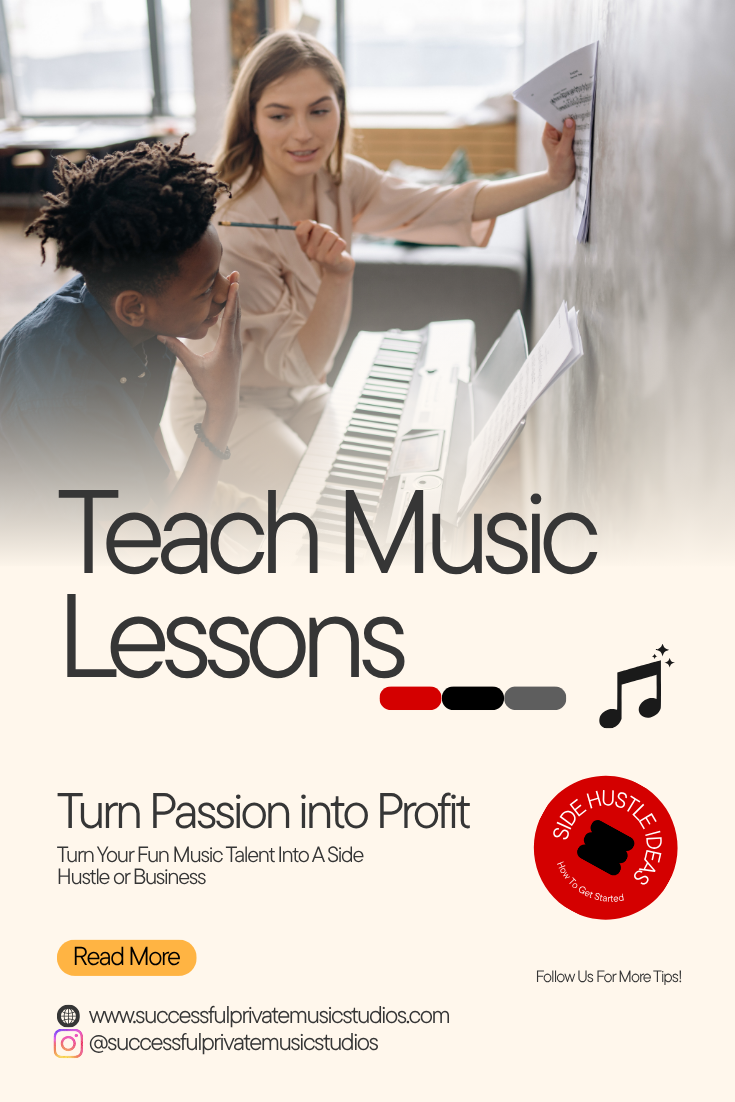
Turn Your Fun Habit Into A Side Hustle or Business

I play French horn with The Charlottesville Band — an 80-piece ensemble filled with talented adult musicians who show up every week because they love music. Retired teachers, engineers, stay-at-home parents, people between jobs, people who love what they do but want something more on the side.
And almost none of them teach lessons.
When I talk to fellow musicians who are retired, looking for supplemental income, or just wondering what to do with the skill they've spent decades developing — the first thing I ask is: have you ever thought about teaching?
Most of them look at me like I suggested something outrageous. But here's the truth: if you play an instrument at an intermediate level or higher, you are already qualified to teach beginners. You don't need a music education degree. You don't need a studio space. You don't need a website or a business plan on day one.
You just need to start.
Why Teaching Makes Sense as a Side Hustle
The math alone is compelling. If you teach just 4 students at $80–$100 per month, that's $320–$400 in income from 4 hours of teaching per week. Scale that to 10 students and you're looking at $800–$1,000 a month from roughly 10 hours of work — doing something you already know how to do.
And unlike most side hustles, private music teaching compounds over time. Students who start as beginners stay for years. Families refer their friends. Your schedule fills through word of mouth before you ever spend a dollar on advertising.
It's one of the few side hustles where the better you get at it, the less you have to hustle.
5 Steps to Get Started Teaching Music Lessons
1. Decide what levels you're comfortable teaching.
You don't have to teach advanced students right away. Most musicians with intermediate skills or higher can confidently teach beginners — and beginners are always the largest portion of the market. Start there and build from experience.
2. Choose your method books.
Don't overthink this. Pick a reputable method book series and stick with it. For piano, Faber & Faber Piano Adventures and Alfred's Basic Piano Library are both widely used and well-structured. For other instruments, ask a local music teacher what they use and start there. Having a clear curriculum makes your first lessons feel organized and professional — for you and your students.
3. Decide your schedule and student capacity.
How many days a week do you want to teach? How many hours? If you teach two afternoons a week for two hours each, that's four 30-minute lessons per session — eight students total. That's a meaningful income from a very manageable time commitment.
Your schedule determines your capacity, so be intentional about it from the beginning. It's much easier to add students later than to scale back a schedule that's already overloaded.
4. Decide where you'll teach.
You have more options than you might think. Teaching from home is the most common choice, but you can also travel to students' homes, rent space at a local music store, or use a church, community center, or other venue. Each option has trade-offs in cost, convenience, and professionalism — choose the one that fits your current situation and adjust as your studio grows.
5. Spread the word and get your first student.
Post a flyer at your local music store, library, or community board. Tell friends and family you're taking students. Post in a neighborhood Facebook group or Nextdoor. Your first student almost always comes from someone you already know — and from there, word of mouth takes over.
Your Complete Starting Point
Music Studio Startup Toolkit
This 65-page toolkit walks you through every foundational decision — business plan, pricing, branding, studio policies, and a 30-day launch roadmap — so you walk into your first lesson with a real plan, not just a hope. If you're ready to turn your musical skill into a real studio business, start here.
$50 · one-time · instant download
Get the Toolkit →Before Your First Student Walks In the Door
Getting students is only half the equation. The other half is setting up your studio like a business from day one — because the habits you build at the start are the ones you'll carry forward.
Two things every new music teacher needs before that first lesson:
A studio policy. This is the document that sets expectations around tuition, cancellations, scheduling, communication, and what happens when things don't go as planned. Without it, you're running on assumptions — and assumptions are where income inconsistency and difficult conversations come from. Get it in writing before you need it.
A simple bookkeeping system. You are now a business owner. That means tracking income, keeping records for taxes, and knowing exactly what your studio earns each month. This doesn't have to be complicated — but it does have to be consistent from the beginning. Starting organized is infinitely easier than trying to untangle a year's worth of records in April.
Done-for-You Templates
Successful Music Studio Policy Templates
Don't write your policy from scratch. These fully customizable templates are already written — covering tuition, cancellations, scheduling, communication, and more. Includes a step-by-step tutorial video to help you customize everything to fit your studio. Two options depending on where you are in your journey.
Advanced adds income growth strategies, student retention, and referral incentive sections.
Ready to Go Beyond the Side Hustle?
Teaching a handful of students is a great start. But if you want to build a studio that's fully booked, consistently profitable, and runs like a real business — that takes a different level of intention.
I've been teaching since I was a junior in high school. I've built my studio twice from scratch after major relocations, reaching full capacity with a waitlist within three months each time. Everything I've learned in nearly three decades of teaching is inside the Signature Course — the complete roadmap for private music teachers who are ready to stop winging it and start building something that lasts.
The Complete Roadmap
Successful Music Studio Strategies — Signature Course
59 lessons covering everything from pricing and branding to student retention, bookkeeping, recitals, and income growth. Built for private music teachers who want a studio that's full, profitable, and sustainable — on their own terms.
$1,250 · or 3 payments of $500
Learn More →You won't know unless you try. And the best time to start is now — before your schedule fills up with everything else, before another year goes by, before another musician in your ensemble tells you they wished they'd started teaching sooner.
Your instrument is already in your hands. The students are out there waiting.
Happy Teaching,
Becky
Keep the momentum going
What do you need help with next?
⭐ Start Here
🗺️ Launch Your Studio
Startup Toolkit · $50 · Business plan, pricing, branding & 30-day roadmap →
📄 Get Your Studio Policy Done
Done-for-You Templates · from $125 · Ready to customize & sign →
🎓 Build a Studio That Runs Like a Business
Signature Course · 59 lessons · Everything to launch & grow →
🗺️ Not Sure Where to Start?
Free · 2 minutes · Start Here page →
Holiday Recitals And How To Squeeze Them In During The Busiest Time of The Year

The holidays are quickly approaching, and you want to showcase your student’s hard work! GREAT! But, how do you make time in your and all your student’s families for a recital?
GET A LOCATION NOW! Start calling around at churches , or facilities asking what is available before you set a date. Or if you already know a date ask specifically for that date.
Be flexible on TIME OF DAY. Sometimes most families have an easier time with midday recitals when they have other activities during the evening.
Use the opportunity to do community service. With Covid, this might not be possible, but for the future, other locations that you can perform are: Retirement or Senior Centers, Malls, Even at the Hospital. You have to get prior permission and there might be other rules attached, but I consider this a Community Service project as a way to give back to the community.
Pick an odd day. Wednesdays and Thursdays seem to be an odd day for many activities and often don’t have a conflict. So try these days instead of a typical Friday or Saturday.
Try to notify your parents AS SOON AS YOU HAVE YOUR RECITAL DATE. And know, that someone might not be able to participate, and that’s okay, it happens. Life is busy at the holidays. goal is to be as early as possible with notifying so they have enough time to put you on their calendar before it fills up over the next month.
Last tip: AIM TO KEEP YOUR RECITAL SHORT! 1-2 songs most, and let the parent’s know you would like to keep it short. Don’t go overboard with the recital. Just some holiday favorites, to show off the progress of your students.
Happy Teaching!
Becky


I’m Becky and Welcome To Successful Music Studio Strategies where I help you create your own Successful Private Music Studio business through simple strategies I’ve learned and used in my own successful private music studio! Want to learn more about my online courses to help you start, build and create a successful and THRIVING music studio? Click here!