

Post Categories: What do you need help with?
Starting Your Studio
Keep Your Studio Running
Making Your Studio Thrive
Strike the Chords of Your Success: A Comprehensive Guide to Hosting a Flawless Online Music Studio Recital

Online recitals aren't a pandemic workaround anymore — they're a legitimate, flexible format that works beautifully for private music studios of every size.
Whether you teach fully online, run a hybrid studio, or just want to offer an alternative to an in-person recital, an online recital can be every bit as special as a live performance. Students still prepare. Families still show up. The nerves are still real. And the sense of accomplishment at the end is exactly the same.
Here's how to run one that feels polished, professional, and worth every hour of preparation.
1. Use the Same Platform You Already Teach On
Don't introduce a new platform just for the recital. If you teach on Zoom, host the recital on Zoom. Your students and families already know how it works — and one less thing to troubleshoot on recital day is worth a lot.
Zoom works well for online recitals because it handles group events reliably, gives you host controls over audio and video, and allows you to admit participants from a waiting room so the timing stays in your hands.
A few Zoom-specific settings to configure before recital day:
Enable the Waiting Room. This lets you control exactly when each participant enters. You can finish setting up, admit families in batches, and keep the start time clean.
Mute participants on entry. Go into your meeting settings and turn on "Mute participants upon entry." This prevents background noise from families joining late from interrupting a performance already in progress.
Disable participant video on entry. You can turn individual cameras on as needed, but starting with video off keeps the opening organized.
Lock the meeting once everyone is in and you're ready to begin — this prevents unexpected guests from dropping in mid-recital.
2. Send Camera and Lighting Instructions Two Weeks Out
The biggest variable in an online recital is video and audio quality — and it's entirely in the families' hands. Don't leave it to chance.
Two weeks before the recital, send every family a clear, specific setup guide. Include:
Camera position: For piano students, request a profile view so you can see both the student's face and their hands on the keys. For other instruments, a slight angle that shows the instrument and the student's face works well. Avoid a straight-on face shot — it tells the audience nothing about what the student is actually doing.
Lighting: Advise families to place a lamp or ring light in front of the student — not behind them. A backlit student looks like a silhouette. A ring light placed slightly above and in front makes a huge difference in how polished the performance looks on screen.
Sound: Ask families to do a quick audio test the day before. Remind them to close windows, silence phones, and reduce background noise as much as possible. A quiet room makes even a simple performance sound more professional.
Device: Recommend a tablet or laptop over a phone if possible — the wider frame captures more of the instrument and the student together.
Send these instructions as a simple numbered list in the email — not a paragraph they have to parse. Make it easy to follow.
Done-for-You Teacher Resources
Teacher Resources — Done for You
Recital programs, parent communication templates, student handouts, and more — all done for you and ready to customize. Stop building every document from scratch and spend that time on what actually matters: your students.
Browse Teacher Resources →3. Send the Recital Link and Password Two Weeks Early
Send the Zoom link and any required password to all families two weeks before the recital — not the week of, not the day before. Two weeks gives families time to forward it to grandparents, aunts and uncles, and anyone else who wants to watch from across the country.
This is one of the hidden advantages of an online recital: geography disappears. A student's grandmother in another state can watch in real time. Family members who could never make it to an in-person recital can be there for this one. Play that up in how you frame it to families — the online format expands the audience, it doesn't shrink it.
Include in your two-week email:
The Zoom link and password
The recital date and start time (with time zone noted if your families span multiple zones)
The camera and lighting setup guide
A reminder that they'll receive the recital program the morning of the event
4. Send the Recital Program the Morning Of
Email the recital program to all families on the morning of the recital and ask them to forward it to anyone joining remotely.
This accomplishes two things: it serves as a same-day reminder that the recital is happening tonight, and it gives every viewer a program to follow so they know who's performing and what order to expect.
Keep the program simple. Student name, piece title, composer. You don't need bios or lengthy descriptions — families are there to listen, not read.
If you want to add a personal touch, include a brief note from you at the top. One paragraph thanking families for their support and celebrating the students' hard work is enough. Keep it warm and short.
Keep Your Studio Running Smoothly
Part 2 — Keeping Your Studio Running
Recitals, scheduling systems, student retention, parent communication, and the organizational strategies that keep your studio running week after week — all in one place. Whether you're teaching in person, online, or both.
$500 · lifetime access
Get Part 2 →5. Keep Your Remarks Short and Your Focus on the Students
This one is worth saying clearly: the recital is not about you. It's about the students.
Keep your introductions brief. A student's name and their piece title is enough. You don't need to share how long they've been studying, what level they're at, or what you've been working on together. That's for a studio newsletter, not a recital introduction.
The same goes for your opening and closing remarks. Thank the families for coming, tell the students you're proud of them, and get out of the way. Two minutes of remarks at the start and two at the end is plenty.
The more efficiently the recital moves, the more the performances themselves — and the students — stand out.
6. Do a Tech Run-Through the Day Before
The one thing that will derail an online recital faster than anything else is a technical problem you didn't anticipate. Run through everything the day before so you're not troubleshooting on recital day.
Your pre-recital checklist:
Test your Zoom link, waiting room, and entry settings
Confirm your mute-on-entry and video settings are saved
Do a test admission from a second device to make sure the waiting room works as expected
Check your own audio and video quality
Have the recital program finalized and ready to send
Confirm you have every family's email address for the morning-of send
Ten minutes of testing the day before saves thirty minutes of chaos on recital day.
A great online recital takes the same thing an in-person recital takes: clear communication, organized preparation, and students who've been given the tools to perform their best. The platform is just the stage.
And if you're looking for a way to build practicing momentum in the weeks leading up to your next recital, the Practice to Performance Spring Challenge Kit is a done-for-you system to keep students consistent and prepared right up to performance day.
Happy Teaching!
Becky
Ready to Build a Studio That Runs Like a Business?
Successful Music Studio Strategies — Signature Course
Recitals are just one piece of the puzzle. The Signature Course covers 59 lessons across every stage of building a thriving private studio — pricing, policies, student retention, bookkeeping, income growth, and more. The complete roadmap for private music teachers.
$1,250 · or 3 payments of $500
Learn More →
Keep the momentum going
What do you need help with next?
⭐ Most Relevant
🌸 Practice to Performance Challenge Kit
Spring Set 1 · $37.50 · Done-for-you · Build recital-ready students →
📄 Done-for-You Teacher Resources
Templates, programs & tools · Ready to customize →
🎓 Keep Your Studio Running
Part 2 Course · $500 · Systems, recitals & retention →
🗺️ Not Sure Where to Start?
Free · 2 minutes · Start Here page →
Why Your Music Studio Needs a Brand (Not Just a Name)
When I first started teaching private lessons, I thought having a studio name was enough. I had business cards made, maybe a basic flyer, and I called it branding. Sound familiar?
Here's what I've learned after nearly 30 years of running a private music studio: a name is just the beginning. Your brand is the whole feeling someone gets when they encounter your studio — before they ever meet you, hear you play, or watch their child learn their first song. And if you're not intentional about that feeling? Someone else is going to define it for you.
What Branding Actually Is (In Plain Language)
Your brand is the combination of your visual identity (colors, fonts, logo, photos), your personality and voice, your values as a teacher, and your niche — who you serve and how you serve them differently. Together, these create a recognizable, trustworthy presence that attracts the right students and families — and quietly turns away the ones who aren't a good fit. That second part is a feature, not a bug.
Why This Matters More Than You Think
Think about the last time you chose a service — a dentist, a hair stylist, a gym. You probably looked at their website, scrolled their Instagram, maybe read a few reviews. Within about 60 seconds, you had a gut feeling about whether they were "for you."
Your prospective studio families are doing the exact same thing. A strong brand builds trust before you ever speak to a parent. It makes your pricing feel justified. It makes your waitlist feel real. It makes people feel like they'd be lucky to get a spot with you.
A weak or inconsistent brand — mismatched colors, a generic logo, a bio written in a totally different voice than your Instagram — quietly signals that things might be a little disorganized behind the scenes. Even if that couldn't be further from the truth.
Limited Time
Holiday Challenge Kit — Set 1
Keep your students engaged and motivated through the holiday season with this ready-to-use challenge kit. Everything you need to run a fun, structured holiday practice challenge in your studio — done for you.
Get the Holiday Kit →You Don't Have to Be a Designer to Have a Strong Brand
This is the part that stops a lot of teachers: they think branding requires hiring a graphic designer, spending thousands of dollars, or having some kind of natural artistic eye. You don't. You need clarity on who you are and who you serve, consistency in how you show up visually and in writing, and a few simple tools (Canva is free and more than enough to start).
The teachers I've seen build the most recognizable studio brands aren't necessarily the ones with the fanciest logos. They're the ones who made deliberate choices and stuck with them.
Done-for-You Teacher Resources
Teacher Resources — Done for You
Templates, tools, and systems built specifically for private music teachers. Stop reinventing the wheel every time you need a new document — grab the done-for-you resources that make running your studio easier every single week.
Browse Teacher Resources →A Quick Exercise to Get You Started
Answer these four questions honestly:
If your studio were a person, how would you describe their personality in three words?
What do you want families to feel when they walk into your studio — or land on your website?
What makes your approach to teaching different from the teacher down the street?
Who is your ideal student, and what does their family care most about?
Your answers are the foundation of your brand. Everything else — colors, logo, taglines, Instagram bios — should grow from there.
Happy Teaching!
Becky
Keep the momentum going
What do you need help with next?
10 Proven Tips for Launching a Successful New Music Teaching Business

Are you passionate about music and eager to share your knowledge with others? Becoming a private music teacher can be a fulfilling and lucrative career path. However, it's not just about having musical skills; communication and recruitment are also crucial aspects of the job.
Get your name out there. Set up a free website to have a landing page for people interested able to start somewhere, because most searches start online. Start hanging flyers up, and advertise at local coffee shops, neighborhood newsletters, and community boards online. Become the name people know and recognize.
Start thinking about how you can effectively communicate with parents. Start practicing answering common questions that are asked. You can see some of the top ones I’ve encountered here. The goal is to get them on the phone and chat with them, or in your door for a trial lesson to make sure things click between you and the family. 🎶 The trial lesson does not have to be free. That’s your choice, but remember, your time is worth something. You can always start offering free trial lessons, and change at a later time too.
Select the method books you are going to be teaching from. There are a lot of choices out there and take the time to sit down with the different method books and decide what you feel most comfortable with. For private piano lessons, I use the Faber & Faber Piano Adventures.
Create your business model and scheduling. To maximize your time spent teaching block off time in your week and schedule all lessons back to back. Have the students come to you if you can and just keep them rolling in one after another. You can teach a lot of students in very little time.
Bookkeeping is essential to track your business. From income tracking, to tuition statements, you will want to have some form of Bookkeeping. I created a mini course with all the Bookkeeping tools I use so you can become a powerhouse too, plus accompanying videos on how to customize all documents on your computer for your studio! Check it out here! Successful Private Music Studios Bookkeeping Powerhouse Mini Course.
Start working on your musicianship skills. You’re going to be teaching others, but still take the time to keep developing yours. From working on a new piece of music to joining a local community ensemble to perform with. 🎶 This creates Credentials that you are actively performing still is a great talking point for why learning music can benefit not just as a child but later in life too. Even if you are just back into picking music back up.
Create a studio policy so that all the questions regarding your music studio is answered before the student comes to the first lesson. That way you establish the rules, sets you up as someone who’s taking this seriously and leaves out any questions for what to do when. You can get my IRONCLAD ready made studio policy template that you can customize to fit your studio. I walk you through exactly how to customize it to truly make it your own. You can get it here: Successful Music Studio Policy Templates Mini Course.
Set a goal for how many students you want to have by a specific date. Then work to start a wait list so that you will always have students in demand ready to walk through your doors.
Think outside of the box when it comes to what you can offer as a teacher. Can you teach more than one instrument, a primary and a secondary? Are you an accompanist? Can you sing? List what you can offer on your website.
Create a fun atmosphere for your students from the moment they walk in the door. Believe it or not, even just having a simple candy bowl from them to take a piece of candy from at the end of lessons, will make them want to come back week after week, year after year. You can also create sticker charts, or challenges for them to work for prizes from a “treasure box”. Practice x amount of days and they get to take a prize from the box. Keeps them engaged and excited.
Becoming a private music teacher can be an exciting and rewarding career path for those who have a passion for music and teaching. Remember that communication, recruitment, forming bonds with your students, and organization are all crucial aspects of the job. With dedication and hard work, you can help aspiring musicians appreciate their artistry and create beautiful sounds through music lessons.
Happy Teaching!
How to Build a Curriculum Path for Intermediate and Advanced Students
Beginning students are the easy part. Most method book series give you a clear, sequential path — you know exactly what comes next, and the books practically plan your lessons for you.
But once a student moves beyond the beginner books? That's where a lot of teachers start winging it. And winging it at the intermediate and advanced level is one of the fastest ways to lose students who are otherwise thriving.
Here's how to think about building a real curriculum path — not a rigid course syllabus, just a clear enough roadmap that your advanced students always know where they're going.
Why It Matters More Than You Think
Advanced students — and their parents — are investing a lot of time and money in lessons. If they can't see a clear direction, they start to wonder if lessons are still worth it. "We've been at this for five years — what are we working toward?" is a question you don't want to hear unprepared.
A curriculum path answers that question before it gets asked. It gives advanced students a sense of purpose and forward movement. It makes your teaching feel intentional, not random. And honestly, it makes your job easier because you're not reinventing the wheel for every intermediate student who walks through the door.
Think in Levels and Landmarks, Not Just Pieces
You don't need to map out every piece a student will ever play. You just need landmarks — the skills, styles, and accomplishments that mark real progress at each stage.
For example, in my own studio I think about intermediate students in terms of what they should be able to do by the time they reach advanced work: solid hands-together playing at a comfortable tempo, basic understanding of music theory and key signatures, experience playing in at least one performance setting. Those are landmarks. The specific pieces we use to get there can flex.
For my High School level Piano students, freshman students work on fugues. Sophomores tackle mini sonatinas. Juniors develop accompaniment skills — they'll actually accompany me on a horn solo, which gives them real ensemble experience. Seniors work toward a senior recital piece. That's a four-year arc with a clear destination. Students can see where they're going, and they stay enrolled to get there.
For my High School level French Horn students each year we have an “in the pocket” easier piece they can perform last minute if needed, Like a Mozart’s 4th Concerto 3rd movememnt Rondo, Saint-Seans’ Romance or Rachamanioff’s Vocalise while working on a bigger standard rep. Specifically when they are a Junior I have them start working on their college audition piece so that by the time they are a Senior they already have it mastered and ready to perform for a concerto competition audition and their college level audition. And for their senior year, they choose their piece they want to work on that is a step up from their College level piece, so when they go to their audition, they already have an impressive audition piece and they can also say they are working on X piece currently for their senior recital.
Create a simple formula of structure to follow and tell them about the plan you have frequently, so they are excited for what is coming next. Plus, you’re reminding them that you have a plan for them and can see them accomplishing that plan and are excited to go on that journey with them. And they will feel like they have more to learn.
Just Getting Started?
Music Studio Startup Toolkit
Before you can worry about advanced curriculum, you need the fundamentals in place — pricing, policies, branding, and a launch plan. The Startup Toolkit covers all of it in 65 pages built for new teachers who want to start right.
$50 one-time · instant download
Get the Toolkit →Layer in Different Styles Deliberately
One thing that separates good intermediate teaching from great intermediate teaching is intentional exposure to different musical styles and eras. Baroque, classical, romantic, contemporary — students who only ever play one kind of music develop a narrow skill set and, eventually, get bored.
You don't have to be rigid about it. A simple guideline like "at least one piece from each major era per year" gives you enough structure to keep things balanced without turning every lesson into a history lecture. Students often discover styles they didn't know they loved when you expose them on purpose rather than by accident.
Make the Path Visible to Students and Parents
You don't have to hand families a formal curriculum document — but having a loose "here's where we're headed this year" conversation at the start of each fall goes a long way. It shows parents you're thinking ahead. It gives students something to look forward to. And it positions you as a teacher with a plan, not just someone filling 30-minute slots.
A simple conversation at the start of the year: "This year I want to focus on building your sight-reading and getting you comfortable with a romantic-era piece. We'll work toward performing both at the spring recital." That's a plan. That's what keeps families enrolled.
Go Deeper
Successful Music Studio Strategies — Signature Course
Curriculum planning, student retention, recitals, income growth — covered in depth across 59 lessons. If you're ready to run your studio like a real business with a plan behind every decision, this is the course.
$1,250 or 3 payments of $500
Learn More →You don't need a perfect system. You just need enough of a plan that your students can see the road ahead. Start there — and refine it as you go.
Happy Teaching!
Becky
What do you want to tackle next?
Here are the best next steps depending on where you are right now.
From Branding to Social Media: Tips to Take Your Music Teaching Business to the Next Level
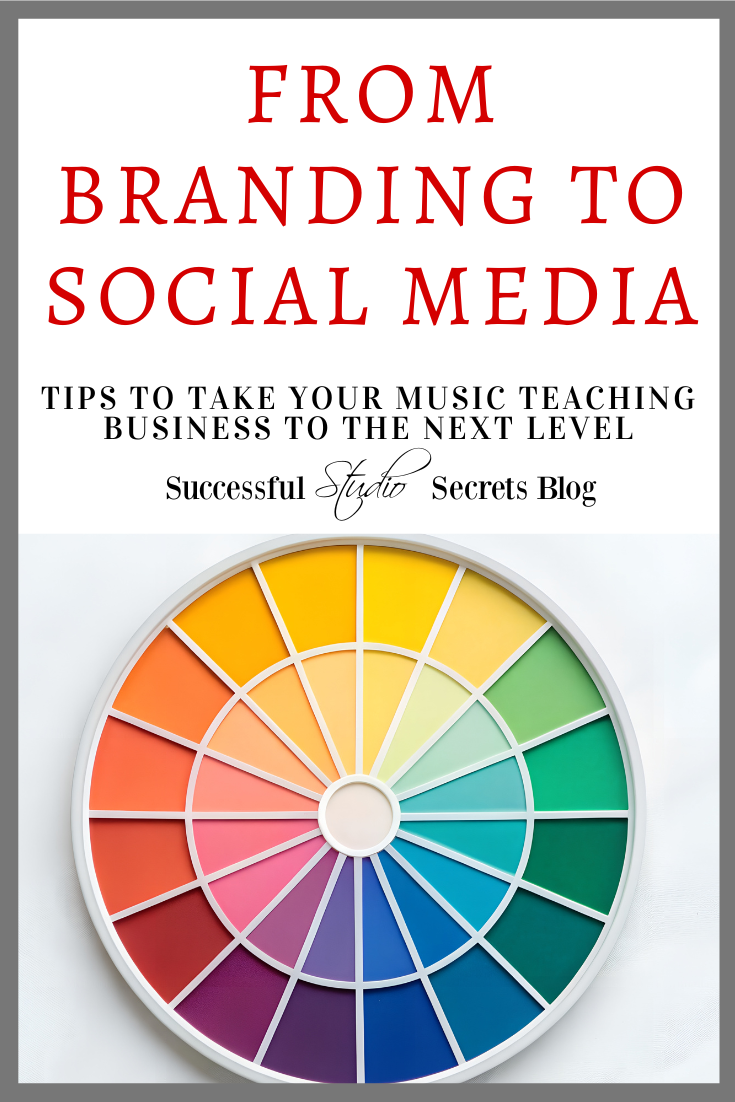
If you’re ready to grow your private music studio this year, there’s one truth you can’t ignore: great teaching is essential, but it’s not the only thing that builds a thriving business.
Your brand identity, your online presence, and the way you show up on social media all work together to shape how families see your studio — long before they ever reach out.
The good news? You don’t need to be a marketing expert to create a studio that feels polished, professional, and uniquely you. With a few intentional steps, you can elevate your studio’s visibility and attract the right students with confidence.
Let’s walk through the essentials.
1. Start With a Clear Brand Identity
Your brand identity is the foundation of your studio’s presence — online and offline. It’s the personality of your business and the promise you make to families.
A strong brand identity includes:
A clear studio name
A consistent color palette and font style
A recognizable logo
A defined teaching philosophy
A tone of voice that reflects your values
A cohesive experience across your website, emails, and social media
When these elements work together, your studio becomes instantly recognizable. Families feel a sense of trust and clarity — and that’s what leads to inquiries and enrollments.
Pro tip: If your studio feels “all over the place,” start by defining three words that describe the experience you want families to have. Warm? Structured? Creative? High‑achieving? Those words become your compass for every branding decision.
2. Make Your Online Presence Consistent and Inviting
Once your brand identity is clear, your next step is making sure it shows up everywhere families interact with you.
That includes:
Your website
Your social media profiles
Your email signature
Your studio policies and welcome packet
Your lesson materials and handouts
Consistency builds trust. When a parent sees the same colors, tone, and message across platforms, they instantly feel like your studio is organized, reliable, and professional.
Ask yourself: Does my online presence reflect the studio experience I want to deliver?
If not, this is the perfect time to refresh and realign.
3. Use Social Media With Intention (Not Exhaustion)
Social media doesn’t have to be overwhelming — especially when you use it strategically.
Here are simple ways to make it work for your studio:
Share content that reflects your brand
If your brand is warm and encouraging, share behind‑the‑scenes moments, student wins, and motivational posts. If your brand is structured and achievement‑focused, highlight practice strategies, progress milestones, and performance prep.
Post consistently — even once a week makes a difference
You don’t need daily content. You just need predictable, steady visibility.
Use captions that speak to parents’ needs
Parents want to know:
What their child will experience
How you support learning
Why your studio is a great fit
Your captions can answer those questions naturally.
Repurpose content to save time
One blog post can become:
3–5 Instagram posts
A Facebook update
A short video
A newsletter segment
You’re not creating more — you’re using what you already have.
4. Build a Studio Presence That Feels Like You
The most successful studios aren’t the ones with the fanciest graphics or the biggest social media following. They’re the ones with a clear identity and a consistent message.
When your branding and social media work together, you create a studio that feels cohesive, trustworthy, and memorable. And that’s what helps families choose you over the dozens of other options in your area.
A Quiet Hint… Something Big Is Coming
If you’re reading this and thinking, “I want to do all of this, but I need a roadmap,” you’re going to love what’s coming next.
The Music Studio Startup Toolkit is about to launch — and it includes an entire section on brand identity, plus templates, scripts, and social media tools to help you build a studio presence that feels polished and professional from day one.
If you want to take your studio to the next level this year, keep your eyes open. The next launch is right around the corner.
Happy Teaching!
Becky


I’m Becky and Welcome To Successful Music Studio Strategies where I help you create your own Successful Private Music Studio business through simple strategies I’ve learned and used in my own successful private music studio! Want to learn more about my online courses to help you start, build and create a successful and THRIVING music studio? Click here!